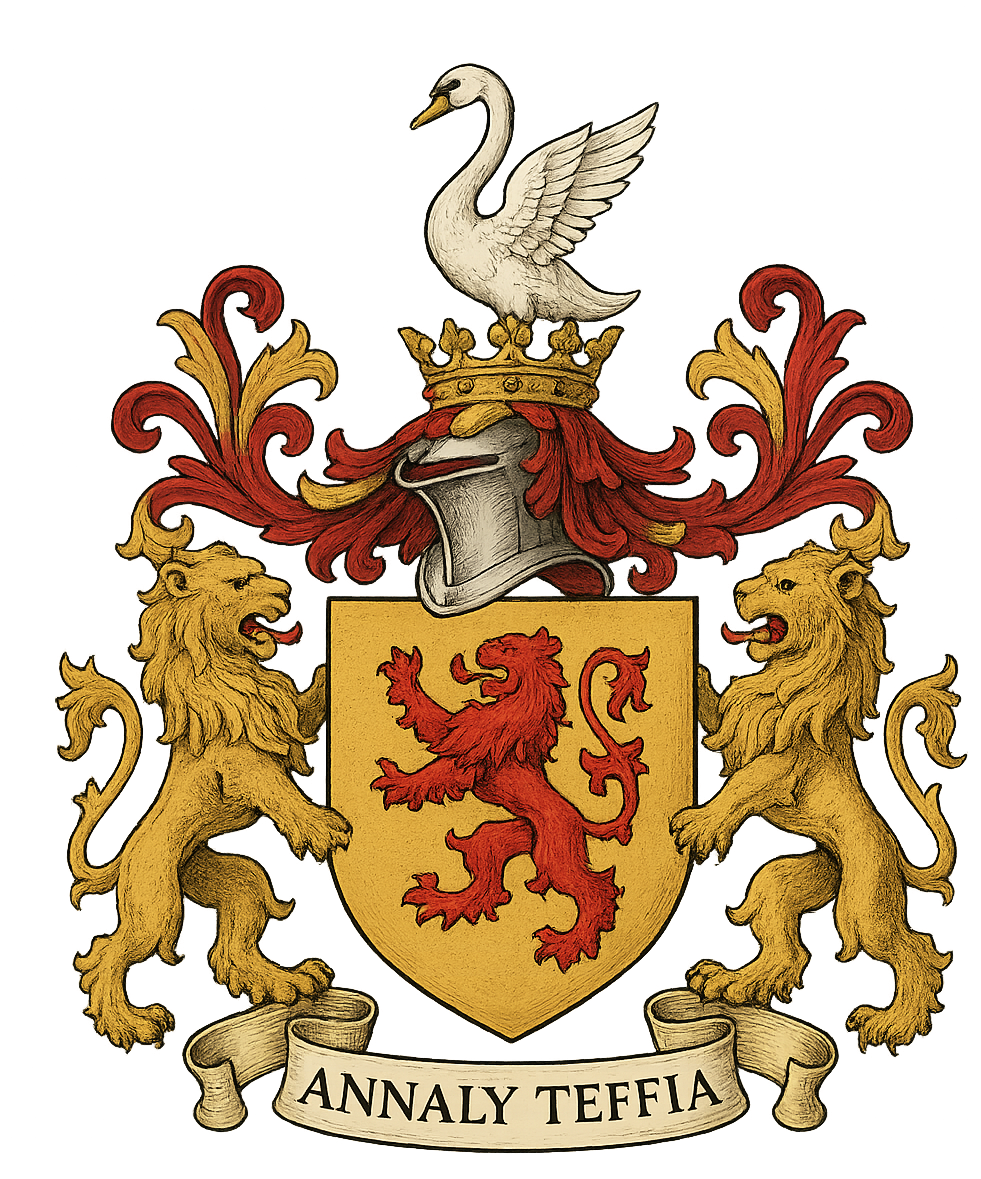
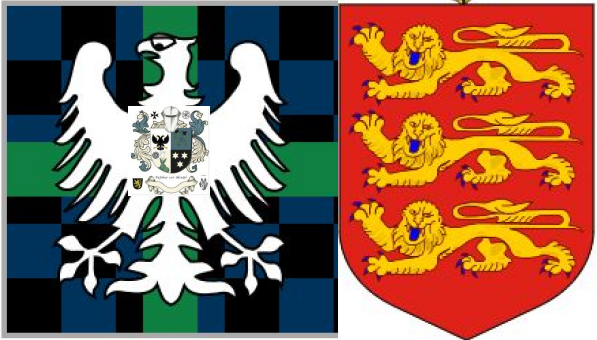
Historically, a great territorial honour or seignory such as
Annaly–Teffia could accumulate multiple descriptive dignities, territorial
styles, ceremonial designations, and feudal appellations over centuries.
These styles often reflected:
- Gaelic princely tradition,
- Norman feudal terminology,
- Anglo-Irish legal usage,
- dynastic continuity,
- territorial jurisdiction,
- and ceremonial prestige.
For a historic dignity associated with Annaly–Teffia–Longford
in
Ireland, the following are examples of styles, dignities, and
appellations that could historically or ceremonially be associated with the
holder.
Territorial & Seigneurial Styles
- Lord of the Honour of Annaly–Teffia
- Lord of Annaly
- Lord of Teffia
- Lord of Longford
- Seigneur of Annaly–Longford
- Seigneur of Teffia
- Seigneur of the Honour of Annaly
- Territorial Seigneur of Annaly
- Dynastic Seigneur of Annaly–Teffia
- Lord Proprietor of Annaly
- Hereditary Lord of Annaly
- Feudal Lord of Annaly
- Lord Paramount of Annaly
- Chief Lord of Teffia
Princely & Dynastic Styles
- Prince of Annaly
- Prince of Teffia
- Feudal Prince of Annaly–Teffia
- Dynastic Prince of Annaly
- Territorial Prince of Longford
- Hereditary Prince of Annaly
- Ancient Prince of Teffia
- Gaelic Prince of Annaly
- Prince Seigneur of Annaly
- Princely Seigneur of Teffia
Gaelic & Historical Irish Forms
Historically, medieval Irish rulers might have been viewed
through Gaelic forms equivalent to:
- Rí Annaly (King of Annaly)
- Princeps Annaliae (Latinized “Prince of
Annaly”)
- Chief of Annaly
- Overlord of Teffia
- Taoiseach of Annaly
- Dynastic Chief of Longford
- Captain of Annaly
- Chief Prince of Teffia
Norman & Feudal Forms
Because honours were often understood within Norman feudal
terminology:
- Lord of the Great Honour of Annaly
- Baron Seigneur of Annaly
- High Seigneur of Teffia
- Grand Seigneur of Annaly
- Seigneur Justicier of Annaly
- Palatine Lord of Annaly
- Feudal Magnate of Longford
Ceremonial & Diplomatic Courtesy Styles
In heritage, academic, ecclesiastical, or ceremonial
settings:
- His Excellency, the Prince of Annaly
- The Most Honourable Lord of Annaly
- The Noble Seigneur of Annaly
- The Worshipful Seigneur of Teffia
- The Illustrious Prince of Annaly
- His Lordship, the Seigneur of
Annaly–Longford
- The Most Noble Prince of Teffia
Composite Grand Styles
Historically inspired composite styles could include:
- His Excellency The Most Honourable Prince of
Annaly–Teffia and Lord of Longford
- The Seigneur and Dynastic Prince of
Annaly
- Lord Paramount and Seigneur of the Honour of
Annaly–Teffia
- The Ancient and Hereditary Prince of
Annaly
- The Lord of the Great Honour and Liberty of
Annaly–Teffia
Legal-Historical Distinction
Historically, these styles arise from several overlapping
traditions:
- Gaelic princely rulership,
- feudal territorial lordship,
- dynastic inheritance,
- incorporeal hereditary dignities,
- and territorial property rights.
Today, such styles are generally:
- ceremonial,
- historical,
- genealogical,
- dynastic,
- or heritage-based,
rather than automatically recognized sovereign titles
under modern international law or diplomatic precedence systems.
Historically, a prince, sovereign lord, territorial seigneur, or dynastic head exercising a
claimed fons honorum (“fountain of honor”) would often create or appoint ceremonial, chivalric,
courtly, administrative, ecclesiastical, and household dignities associated with the principality, court,
or seignory.
In medieval and early modern Europe, especially in princely houses, palatine courts,
seignories, and honors, these offices could range from substantive governmental functions to purely
ceremonial or dynastic honors.
For a ceremonial principality or historic territorial honor such as Annaly–Teffia in
Ireland, examples of traditional-style appointments and dignities could
include the following.
High Court & State Offices
| Title |
Traditional Role |
| Lord Chancellor |
Keeper of seals, legal affairs, chief counselor |
| Lord Steward |
Head of household and estates |
| Lord Chamberlain |
Ceremonial master of court |
| Seneschal |
Feudal administrator |
| Constable |
Military or ceremonial commander |
| Marshal |
Ceremonial or military organizer |
| High Justiciar |
Judicial authority |
| Lord High Treasurer |
Financial officer |
| Master of Ceremonies |
Court protocol |
| Herald or King of Arms |
Heraldry and genealogy |
| Keeper of the Privy Seal |
Seal and authentication authority |
| Grand Secretary |
State correspondence |
| Castellan |
Keeper of castle or fortress |
| Admiral of the Principality |
Ceremonial maritime office |
Feudal & Territorial Offices
| Title |
Function |
| Bailiff |
Territorial administrator |
| Provost |
Judicial or local officer |
| Reeve |
Estate overseer |
| Steward of the Manor |
Estate administration |
| Warden of the Marches |
Border authority |
| Ranger of the Forest |
Custodian of forests |
| Keeper of the Liberty |
Liberty jurisdiction officer |
| High Sheriff |
Ceremonial enforcement office |
| Master Forester |
Hunting/land officer |
Chivalric & Noble Honors
| Title |
Purpose |
| Knight Commander |
Senior knightly dignity |
| Knight Grand Cross |
High order of merit |
| Companion of the Order |
Chivalric membership |
| Baron of the Principality |
Territorial/baronial dignity |
| Count Palatine |
Ceremonial comital dignity |
| Seigneur |
Feudal landed dignity |
| Laird |
Scottish-style landed dignity |
| Banneret |
Battlefield or ceremonial knighthood |
Ecclesiastical & Religious Offices
| Title |
Traditional Use |
| Prince-Chancellor |
Church-state ceremonial office |
| Grand Prior |
Head of religious order |
| Canon |
Ecclesiastical dignity |
| Preceptor |
Religious administrator |
| Protector of the Faith |
Ceremonial defender role |
| Defender of the Church |
Dynastic church patron |
Academic & Honorary Appointments
| Title |
Function |
| Court Historian |
Official historian |
| Royal Archivist |
Keeper of records |
| Poet Laureate |
Literary honor |
| Court Philosopher |
Intellectual office |
| Royal Professor |
Academic appointment |
| Fellow of the Principality |
Learned society dignity |
Household & Ceremonial Court Titles
| Title |
Function |
| Gentleman of the Court |
Court membership |
| Lady of Honour |
Ceremonial attendant |
| Equerry |
Personal attendant |
| Cup Bearer |
Ancient ceremonial office |
| Sword Bearer |
Ceremonial office |
| Standard Bearer |
Banner carrier |
| Keeper of the Regalia |
Custodian of insignia |
Diplomatic & International Titles
| Title |
Role |
| Ambassador Extraordinary |
Ceremonial envoy |
| Envoy Extraordinary |
Diplomatic representative |
| Minister Plenipotentiary |
Historical diplomatic title |
| Consul of the Principality |
Trade/diplomatic representative |
| Legate |
Ecclesiastical/diplomatic envoy |
Styles Often Associated with Appointment
A prince or lord exercising ceremonial fons honorum might grant:
- Orders of merit,
- knighthoods,
- household offices,
- heraldic honors,
- court appointments,
- ecclesiastical patronage,
- honorary fellowships,
- or territorial dignities.
Historically inspired prefixes might include:
- The Right Honourable
- The Most Honourable
- The Noble
- Sir
- Dame
- Chevalier
- Baron
- Count
- Seigneur
- Knight Commander
- Grand Officer
- Companion
Important Historical Distinction
Historically, true fons honorum was associated with:
- sovereign monarchs,
- reigning princes,
- mediatized princely houses,
- or legally recognized dynastic authorities.
Today, outside recognized sovereign systems, such appointments are generally:
- ceremonial,
- private,
- dynastic,
- ecclesiastical,
- or associative,
rather than state-recognized nobiliary creations under public international law;
however:
The historic Honour and Seignory of Annaly–Teffia
occupies a unique position within the constitutional and property
traditions of
Ireland because it is rooted
not merely in social courtesy or ceremonial nobiliary custom, but in a
continuing hereditary territorial property right associated with an ancient
honour, seignory, and dynastic principality. Historically, the dignities
connected with Annaly–Teffia derive from the ownership and succession of a
recognized incorporeal hereditament — a form of intangible hereditary
property long recognized within the common law and constitutional
traditions inherited in Ireland.
Historically, fons honorum — the “fountain of honour” — was
associated with sovereign monarchs, reigning princes, dynastic houses,
and territorial authorities possessing the lawful capacity to confer
dignities, honors, appointments, and hereditary distinctions. In many
continental European nations, however, such historic rights were
abolished, nationalized, or constitutionally extinguished during
revolutionary and republican reforms.
For example:
-
Germany largely abolished
sovereign noble privileges and converted titles into mere surname
components after the Weimar Constitution;
-
Austria formally
abolished noble titles entirely under the Adelsaufhebungsgesetz of
1919;
-
France dismantled feudal
and territorial dignities during the French Revolution;
-
Italy ceased formal state
recognition of noble titles after the establishment of the
republic;
- and
Russia extinguished
hereditary aristocratic legal structures following the Bolshevik
Revolution.
By contrast, the Annaly–Teffia dignity is argued to
survive not primarily as a sovereign state title, but as a hereditary
territorial and constitutional property right connected to an historic
honour and seignory. Under this view, the associated dignities arise
from the continuing ownership of the Honour itself — an incorporeal
hereditary asset tied to ancient territorial jurisdiction, dynastic
succession, and hereditary proprietary rights rather than solely from
governmental recognition.
Thus, Annaly–Teffia may be regarded as possessing a
stronger surviving proprietary and hereditary foundation than many
extinguished continental titles because the dignity is connected to a
continuing territorial hereditament rather than merely a socially
recognized aristocratic designation. The associated styles, dignities,
and ceremonial rights are therefore viewed as incidents appurtenant to
the Honour and territorial seignory itself.
In this framework, the holder of Annaly–Teffia is not
merely claiming a courtesy title, but asserting succession to an ancient
territorial honour whose associated dignities, ceremonial offices,
hereditary styles, and dynastic privileges descend as proprietary rights
attached to the historic seignory. This distinction places Annaly–Teffia
within a rare class of surviving hereditary territorial honors whose
legitimacy is argued to rest upon property law, constitutional
continuity, hereditary succession, and incorporeal hereditament
principles rather than solely upon modern sovereign recognition.
Accordingly, the dignities historically associated
with Annaly–Teffia — including styles such as Prince of Annaly, Seigneur
of Annaly–Longford, Lord of the Honour of Annaly–Teffia, and related
ceremonial and dynastic appointments — are viewed as derivative rights
flowing from the ownership and succession of the Honour itself. In this
sense, Annaly–Teffia represents not simply a historical title, but a
continuing constitutional and hereditary territorial asset preserving
aspects of Ireland’s ancient princely and seigneurial traditions into
the modern age.
|