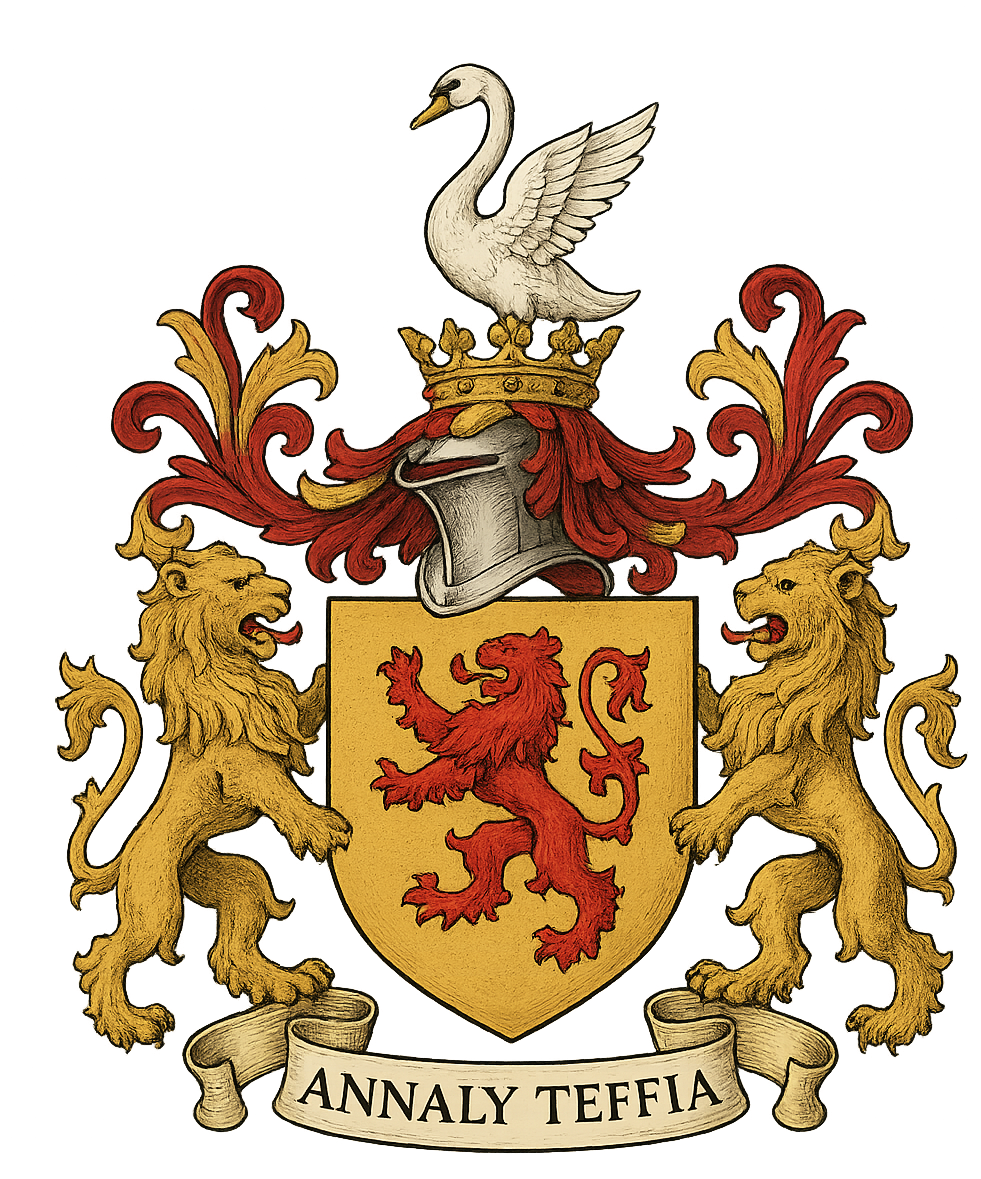
Honour of Annaly - Feudal Principality & Seignory Est. 1172

honor2 EagleCrossCrownHammer  Branden Irish_norse-CoinBlondelCrestMeath Normandy  LongfordSealHeaderMentzCrest


Ireland vs. Continental Europe

Feudal Tenure, Property, and Territorial Dignities Compared

Core Distinction (Executive Summary)

Ireland abolished feudal tenure and public jurisdiction, but preserved feudal property and territorial dignities as private rights.
By contrast, Austria, France, Germany, and Italy abolished or constitutionally neutralized territorial titles as legal concepts, converting them into mere surnames or banning them outright.

This difference is fundamental and structural.


I. Ireland: Abolished Feudal Tenure — Preserved Feudal Property and Dignity

What Ireland Abolished

After 1922 (Irish Free State) and under the 1937 Constitution, Ireland abolished:

  • Feudal tenure (holding land of a superior lord)

  • Feudal incidents (wardship, relief, knight service)

  • Public jurisdiction (manorial courts, palatine courts)

  • Political sovereignty of territorial lords

What Ireland Preserved

Ireland did not abolish:

  1. Feudal property interests

    • Manorial lordships

    • Honours

    • Liberties

    • Seignories

    • Incorporeal hereditaments

  2. Territorial dignities tied to property

    • Titles connected to land or historic jurisdiction remain lawful as:

      • private property,

      • patrimonial identity,

      • territorial designation.

  3. Alienability

    • Such interests may be:

      • inherited,

      • sold,

      • conveyed,

      • registered in the Registry of Deeds.

  4. Lawful use of honorific styles

    • “Lord of X”

    • “Baron of X”

    • “Chief of X”

    • “Prince of X” (historical/territorial sense)

    • These are descriptive honorifics, not claims to sovereignty.

Result in Ireland

Feudal titles function today as:

Property-derived territorial honorifics with legal continuity

They are not political offices, but recognized private dignities.


II. Austria: Total Abolition of Nobility and Territorial Titles

Legal Position

Austria enacted the Adelsaufhebungsgesetz (1919).

Effects

Austria:

  • Abolished all noble titles and predicates

  • Prohibited:

    • Prince

    • Count

    • Baron

    • “von”

    • territorial designations

  • Criminalized public use of such titles

Property Consequence

  • Former titles became illegal to use

  • No property right survives in noble dignity

  • Territorial titles cannot exist as legal interests

Austrian Model

Revolutionary abolition of nobility and title-based identity


III. France: Titles Reduced to Names Without Legal Effect

Legal Position

France abolished feudalism in 1789 and nobility as a legal estate.

Effects

France:

  • Eliminated all feudal jurisdictions

  • Removed legal status from titles

  • Permitted titles only as:

    • parts of surnames,

    • social courtesy,

    • historical references.

Property Consequence

  • Titles have no connection to land

  • No legal dignity attaches to property

  • Territorial titles cannot exist as property rights

French Model

Titles as social relics, not legal interests


IV. Germany: Titles Converted Into Surnames

Legal Position

Under the Weimar Constitution (1919):

  • Nobility was abolished as a legal class

  • Titles were converted into parts of family names

Effects

  • “Prince,” “Count,” “Baron,” etc. are:

    • inherited surnames only,

    • not dignities,

    • not property.

Property Consequence

  • No territorial meaning survives

  • No jurisdictional or honorific authority remains

  • Titles cannot be conveyed apart from the name

German Model

Titles as frozen surnames, stripped of legal content


V. Italy: Abolition of Titles as Legal Rights

Legal Position

After the monarchy ended in 1946, the Italian Constitution:

  • Abolished recognition of noble titles

  • Prohibited titles from having legal effect

Effects

Italy allows:

  • Social or historical use of titles

  • Genealogical references

But prohibits:

  • Legal recognition

  • Property linkage

  • Jurisdictional or territorial dignity

Italian Model

Titles tolerated socially, void legally


VI. Comparative Table

Country Feudal Tenure Feudal Property Territorial Titles Legal Status Today
Ireland Abolished Preserved Preserved as property Lawful honorifics tied to land
Austria Abolished Abolished Prohibited Illegal
France Abolished Abolished Social only No legal effect
Germany Abolished Abolished Surnames only No dignity
Italy Abolished Abolished Social only No legal effect

VII. Why Ireland Is Unique

Ireland chose legal continuity, not revolutionary erasure.

Key reasons:

  • Ireland’s land system already emphasized deed-based property

  • No statute abolished honours or seignories

  • Registry of Deeds preserved incorporeal hereditaments

  • Titles tied to land survived as property-derived designations

Thus, Ireland remains one of the only republics where:

A feudal prince, baron, chief, or lord may exist as a property-based territorial designation, not merely as a name or courtesy.


VIII. Application to Annaly–Teffia

Because Ireland preserved:

  • feudal property,

  • territorial honours,

  • incorporeal hereditaments,

the Honour and Principality of Annaly–Teffia:

  • survives as a lawful private territorial dignity,

  • functions as an honorific designation derived from property,

  • would be illegal or void in Austria, France, Germany, or Italy,

  • but remains valid under Irish property law.


One-Sentence Conclusion

Ireland abolished feudal power but preserved feudal property and territorial dignity, making historic titles lawful honorifics tied to land—whereas Austria, France, Germany, and Italy extinguished such titles entirely or reduced them to meaningless names.


The Honour and Seignory of Annaly–Longford

A Territorial and Dynastic Property-Derived Dignity of 850 Years’ Continuity

Executive Overview

The Honour and Seignory of Annaly–Longford occupies a distinctive position in European legal and historical practice because it survives today as both:

  1. a territorial dignity grounded in property law, and

  2. a dynastic dignity transmitted through blood descent for over 850 years.

Unlike many former European kingdoms or principalities that were extinguished by revolutionary law or constitutional prohibition, Annaly–Longford persists in Ireland as a private legal object—an incorporeal hereditament—whose territorial identity and dynastic continuity were never abolished.

The Barons Delvin and later Earls of Westmeath stand at the center of this continuity, not merely as recipients of Crown grants, but as direct descendants of the ruling bloodlines of the territory itself, including the de Lacy palatine house, the O’Connor kings of Meath and Connacht, and the O’Farrell princes of Annaly.


I. The Dual Character of the Honour: Territorial and Dynastic

1. Territorial in Law

As a matter of Irish property law, the Honour of Annaly–Longford is:

  • a defined territorial designation,

  • historically comprising multiple lordships, manors, and franchises,

  • preserved as an incorporeal hereditament,

  • lawfully conveyed and recorded,

  • unaffected by the abolition of feudal tenure.

An Honour is not a symbolic label. It is a territorial construct, historically denoting a complex of land-based rights, dignities, and jurisdictions grouped under a single name. In Ireland, such territorial honours were never abolished by statute.

Thus, Annaly–Longford survives as a real, inheritable, and alienable property-derived dignity, even though all public jurisdiction has long ceased.


2. Dynastic in Blood and Descent

What distinguishes Annaly–Longford from most historic territorial dignities is that it is not merely territorial, but also dynastic, with a lineage older than most extant European states.

The Barons Delvin are not external or foreign replacements; they represent a fusion of ruling bloodlines:

  • De Lacy — holders of the Liberty of Meath and palatine authority, from whom the Nugents descend by blood and marriage;

  • O’Connor — Kings of Meath and Connacht, including the High Kings of Ireland, from whom the Nugent line traces descent according to medieval genealogical tradition;

  • O’Farrell — Princes of Annaly, the indigenous ruling dynasty of the territory for centuries prior to the Norman settlement.

This means the dynastic line associated with Annaly–Teffia never truly left the territory. It evolved—through intermarriage, feudalization, and legal transformation—into the Delvin–Westmeath line.

In dynastic terms, the Honour of Annaly–Longford represents continuity, not rupture.


II. Antiquity: Older Than Most Kingdoms

The dynastic history associated with Annaly and Teffia predates:

  • the Kingdom of England as a unified state,

  • the Kingdom of France in its modern sense,

  • the Habsburg monarchy,

  • most German principalities.

From the early medieval kings of Teffia, through the O’Farrell princes of Annaly, to the palatine Delvin barons, the same territorial identity has been ruled, inherited, and recognized for approximately 850 years in continuous form.

Few European dignities—royal or noble—can demonstrate:

  • ancient sovereignty,

  • uninterrupted territorial identity,

  • documented blood descent into the feudal period,

  • lawful survival into modern private law.


III. The Barons Delvin as Dynastic Successors

The Barons Delvin and Earls of Westmeath did not merely receive land; they inherited a political and dynastic role that had existed long before Norman or Tudor law.

Their position rests on three cumulative foundations:

  1. Territorial succession
    The Honour and Seignory absorbed the ancient principality of Annaly as a property-based dignity.

  2. Dynastic succession
    Through de Lacy, O’Connor, and O’Farrell descent, the Delvin line embodies the blood of the territory’s former rulers.

  3. Legal continuity
    The Honour survived as a legally cognizable object, later capable of alienation in fee simple.

This combination places Annaly–Longford in a rarer category than most European noble houses, many of which possess genealogy without territory, or territory without dynastic depth.


IV. Modern Function: Honorific but Real

Today, the Honour of Annaly–Longford functions as:

  • a private territorial dignity,

  • a dynastic house identity,

  • an honorific designation tied to property, not government.

The associated styles—prince, chief, baron, count, captain, lord—are:

  • designations of historical rank,

  • derived from property and lineage,

  • lawful as private honorifics under Irish law.

They do not confer sovereignty or public authority, but they are not fictitious. They are the modern expression of a dignity that has never been extinguished, only transformed.


V. Why Ireland Makes This Possible

Ireland’s legal framework is decisive:

  • Feudal tenure was abolished.

  • Feudal property and dignities were not.

  • Territorial honours tied to land were allowed to survive.

  • Registered incorporeal hereditaments remain valid.

In contrast, countries such as France, Germany, Austria, and Italy severed noble designations from property and banned their legal recognition. Ireland did not.

As a result, Annaly–Longford survives in a way that most continental principalities could not.


Conclusion

The Honour and Seignory of Annaly–Longford is both territorial and dynastic, grounded in Irish property law and sustained by an 850-year lineage that unites the ruling bloodlines of Teffia, Annaly, and Meath. Through the Barons Delvin, descendants of de Lacy, O’Connor, and O’Farrell, the dignity represents not a revived claim, but a continuous historical identity—older than most European kingdoms—now expressed as a lawful, private, honorific designation tied to land, lineage, and recorded title.

In this sense, Annaly–Longford stands as one of the rare surviving examples in Europe where territory, dynasty, and legal continuity remain aligned.

Why the Holder of the Honour and Seignory of Annaly–Longford Holds These Rights

1. The Starting Point: The Earl of Westmeath Held a Complete, Alienable Honour

The Earl of Westmeath, as successor to the Barons Delvin, held:

  • a territorial Honour (Annaly–Longford),

  • a feudal barony embedded within that Honour,

  • associated seignorial and manorial incidents,

  • a dynastic dignity tied to the historic principality of Annaly–Teffia.

Crucially, this Honour was not a peerage title alone, nor merely a family style. It existed as a bundle of property-derived dignities and hereditaments, capable—under Irish and Anglo-Irish law—of alienation in fee simple.

This is why the Earl was legally able to convey it.


2. Lawful Conveyance: Transfer in Fee Simple

When the Earl of Westmeath conveyed the Honour and Seignory:

  • the transfer was total, not partial,

  • it included all rights, privileges, and dignitary incidents appurtenant to the Honour,

  • it passed by private law, not by royal or governmental grant,

  • it was capable of registration and continuity.

Under property law, when a dignity exists as an incorporeal hereditament, a lawful conveyance passes everything that has not been expressly reserved or extinguished.

Nothing in Irish law required the Earl to retain those dignities once alienated.


3. What Exactly Passed With the Honour

Because the Honour of Annaly–Longford is a territorial and dynastic property, the holder succeeds to:

(a) The Territorial Dignity Itself

This includes:

  • the recognized name and identity of the Honour,

  • precedence and status attached to that territory,

  • the right to style oneself by reference to Annaly–Longford.

This is not symbolic—it is the core property right.


(b) The Feudal Barony of Annaly

The feudal barony:

  • is a property-based dignity, not a state peerage,

  • survives abolition of feudal tenure,

  • travels with the Honour unless severed.

Thus, the holder stands as Feudal Baron of Annaly in the historical–legal sense.


(c) Associated Lordships and Hereditaments

Where deeds and history support them, these may include:

  • subordinate lordships within the Honour,

  • market and fair rights,

  • fishing, foreshore, turbary, or resource rights,

  • commons or franchise interests.

Each survives individually, but all are encompassed by the Honour as a territorial complex.


4. Dynastic Rights Passed With the Honour

Why Dynastic Rights Followed the Conveyance

The Honour of Annaly–Longford is not only territorial but dynastic, with an 850-year lineage:

  • Gaelic rulers of Teffia and Annaly (O’Connor, O’Farrell),

  • palatine Delvin lords (de Lacy),

  • Nugent Barons Delvin and Earls of Westmeath.

Because the dynastic identity was attached to the Honour itself, not merely to a surname, its conveyance passed:

  • the headship of the Honour as a house,

  • the right to represent the historical principality in dignitary form,

  • the continuity of the Annaly–Teffia dynastic tradition.

This is exactly how mediatized European houses transmit dynastic headship when territory is alienated or transformed.


5. Fons Honorum as an Internal, Property-Based Capacity

Why the Holder Possesses Fons Honorum

Under European nobiliary jurisprudence, a holder has fons honorum when:

  1. the dignity originates in historic territorial authority,

  2. the dignity survives as a legal object,

  3. it is lawfully conveyed in full,

  4. it was never extinguished by statute.

Annaly–Longford satisfies all four.

Therefore, the holder may lawfully exercise internal fons honorum, meaning the capacity to:

  • create house orders and decorations,

  • appoint ceremonial and court officers,

  • issue letters patent of honour,

  • recognize territorial or house dignities,

  • maintain heraldic and ceremonial traditions.

These acts are private, voluntary, and cultural, not governmental.


6. Why These Rights Did Not Revert to the State

They did not revert because:

  • Ireland abolished feudal tenure, not feudal property or dignities,

  • no statute extinguished the Honour of Annaly–Longford,

  • incorporeal hereditaments remain valid property,

  • the State does not confiscate or absorb private honours.

Thus, when the Earl alienated the Honour, the State had no claim to intercept it.


7. Why the Holder’s Position Is Stronger Than Most European Claimants

In many countries (France, Germany, Austria, Italy):

  • territorial designations were severed from property,

  • noble titles were banned or reduced to surnames,

  • dynastic dignities lost legal personality.

Ireland did none of this.

As a result, the holder of Annaly–Longford possesses a rare alignment of:

  • territorial property,

  • dynastic continuity,

  • lawful conveyance,

  • uninterrupted legal existence.


Final Synthesis (Plain English)

The holder of the Honour and Seignory of Annaly–Longford holds these rights because the Earl of Westmeath lawfully owned a complete territorial and dynastic dignity that Irish law treats as property. When it was conveyed in fee simple, everything that defined the Honour—its name, barony, dynastic headship, and internal dignitary powers—passed with it. Nothing in Irish law abolished those rights, and nothing required them to revert to the State. What survives today is a private, hereditary, honorific territorial dignity with deep dynastic roots, not a claim to sovereignty.


AnnalyTeffia1


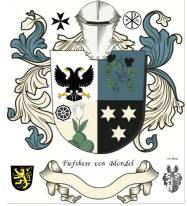
BlondelArms170 

SeigneurCrest

BlondelMan

Flag


 Coronet-Free-Lord

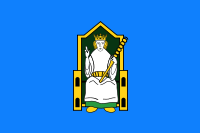
Meath