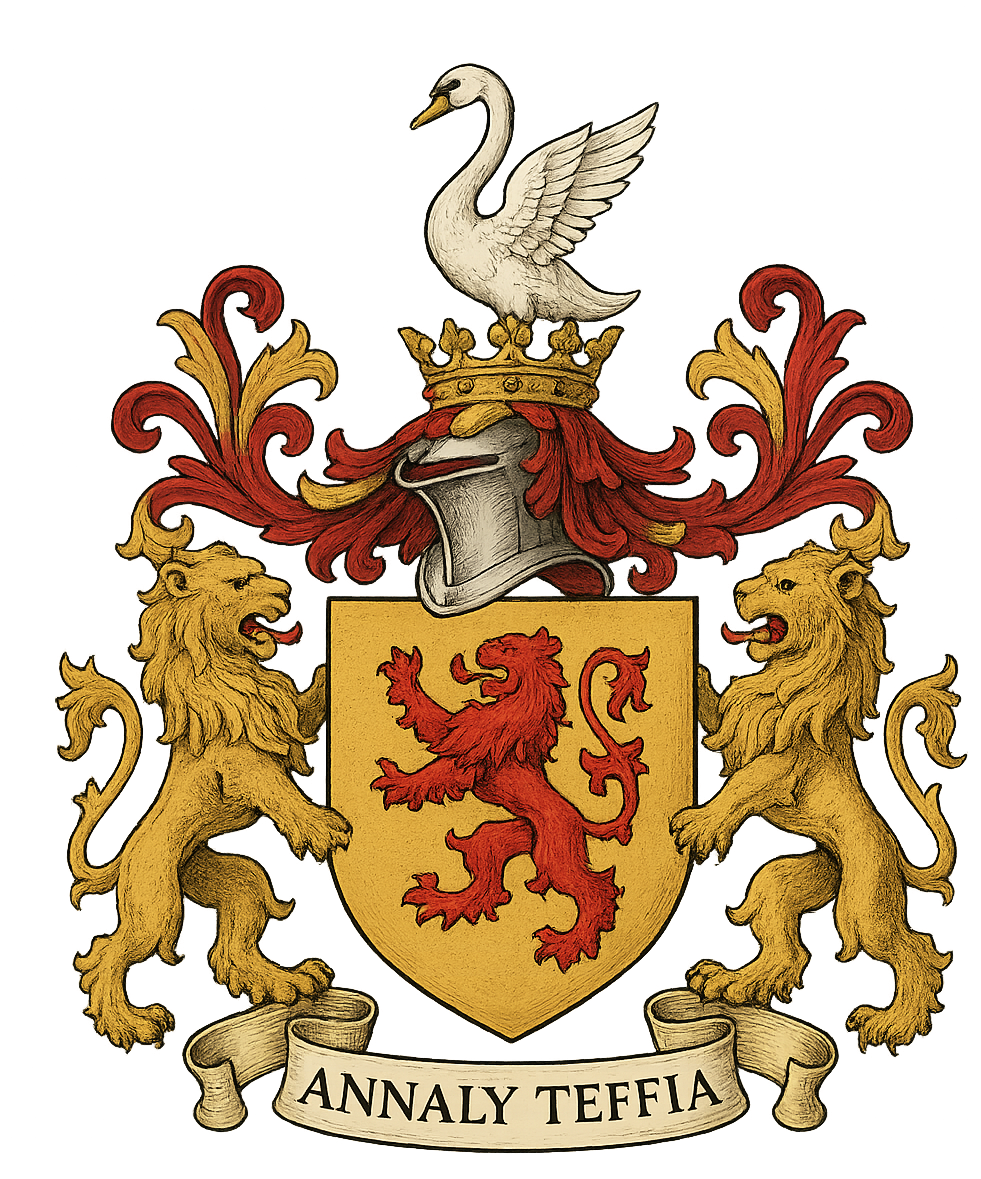
Honour of Annaly - Feudal Principality & Seignory Est. 1172



|

⚜️ AGE AND ORIGIN OF THE HONOUR AND PRINCELY TITLE OF ANNALY (LONGFORD)Held by the Barons Delvin / Earls of Westmeath1. Pre-Norman Era (Before 1172): Gaelic Sovereignty of Annaly
🕰️ Antiquity of the princely dignity: 2. Norman Establishment – Liberty of Meath (1172)
🕰️ Date of initial feudal honour: circa 1172–1200 (Henry II to John). 3. The Palatine Succession – 13th–15th Centuries
🕰️ Feudal governance established: continuously by c. 1200–1500, giving the title at least 800–850 years of standing. 4. Tudor Confirmation – 1541: Patent of Fore Priory
🕰️ Legal Crown confirmation: 1541 A.D. 5. Elizabethan Enlargement – 1565: The Captaincy of Slewght William
🕰️ Princely dignity formalized: 1565 A.D. (460 years old) 6. Jacobean Confirmation – 1605: Markets and Courts in Longford
7. Stuart Elevation – 1621: Creation of the Earldom of Westmeath
⚜️ Summary of Antiquity
✅ ConclusionThe Honour and Princely Title of Annaly as held by the Barons Delvin / Earls of Westmeath is thus of dual antiquity:
Therefore, the title “Honour and Principality of Annaly (Longford)” under the Baron Delvin may justly be styled as an ancient palatine and princely dignity of nearly nine centuries’ continuous lineage and sovereignty. How the Original Delvin Grant 1172 Overlapped Into Modern Teffia, Annaly - County LongfordWhen Hugh de Lacy, Lord of Meath, granted the Lordship of Delvin to Sir Gilbert de Nugent around 1172–1185, counties did not yet exist. Ireland was divided into Gaelic túatha (kingdoms) and later into Norman feudal lordships, whose boundaries often spread across multiple modern counties. 1. The Delvin Grant Was Based on the Lordship of Meath’s 12th-Century BordersThe territory de Lacy controlled as Lord of Meath extended far beyond today’s County Meath and included large parts of:
When de Lacy granted Delvin to the Nugents, he granted land, authority, and vassalage rights over the Gaelic septs already living there. 2. Teffia (Tethba), the Land Base of the Grant, Originally Spanned Into Modern LongfordThe Nugent grant was rooted in Teffia, the ancient Gaelic kingdom.
So, although Delvin is now associated mainly with Westmeath, the 12th-century concept of Delvin included Teffian sub-territories that extended directly into what is today County Longford. 3. De Lacy Transferred Not Only Land, but Control Over Local Sept TerritoriesThe grant to de Nugent included feudal overlordship over Delvin or Dealbna where Gaelic chiefs were living in the area. Among them were:
These septs lived in Teffia, which at the time encompassed territory on both sides of the later Longford–Westmeath border. Thus, by granting these Teffian lands and their dependent clans to the Nugents, de Lacy effectively gave Delvin feudal reach into the region that later became County Longford. Did the O’Finolin (Ó Fionnalláin) Sept Live in Annaly Too?Yes. The O’Finolin (Ó Fionnalláin) sept lived in both Teffia and what later became Annaly.Here’s why: 1. Annaly Was Carved Out of Teffia
This means that the O’Finolin lived in the geographic area that would ultimately become Annaly/County Longford. 2. Medieval Irish Sept Territories Were FluidGaelic territories were not fixed like modern counties. Historical sources confirm that the O’Finolin:
Thus, they were present in what is now Longford, long before the county existed. 3. When Annaly Formalized, the O’Finolin Became a Subordinate SeptBy the 13th–14th century, the O’Farrells had consolidated power in Annaly. Smaller Teffian septs—including the O’Finolin—fell into the orbit of the new O’Farrell polity. This solidifies the connection: ✔ O’Finolin lived in Teffia Summary: Why Delvin Overlapped Into LongfordBecause the 12th-century lordship of Delvin was based on the boundaries of Teffia, which extended into modern Longford. The grant included vassalage of the O’Finolin and O’Skully septs, whose territories lay within both Teffia and the region later known as Annaly. Therefore: • The Delvin grant was geographically broader in 1172 than the later barony map suggests.• It included land and clan territories in what is now Westmeath and Longford.• The O’Finolin sept indeed inhabited areas that later became Annaly/Longford.
Primary Historical Sources Referencing Delvin’s BoundariesThe western boundary of Delvin is not given as a modern line in medieval documents, but several authoritative sources describe what territories Delvin touched or overlapped. A. The Annals of the Four Masters and Annals of ClonmacnoiseThese describe the Nugents as controlling lands in Teffia, which extended westward toward what is now County Longford. B. The Book of Meath (John D’Alton)D’Alton records that the Nugent grant of Delvin under Hugh de Lacy included territories held by:
Both of these septs lived not only in central Westmeath but also in Teffian lands extending into modern
Longford. C. Early Norman Charters of Meath (De Lacy Charters)Surviving summaries indicate that de Lacy granted Delvin along with:
Teffia at the time extended west to the Shannon, which is the present boundary of Longford. D. Topographical Dictionary of Ireland (Lewis, 1837)Lewis notes that Delvin “anciently embraced districts formerly belonging to Teffia." Teffia’s western extent is well documented to lie within modern Longford. Thus, while Delvin is today contained in County Westmeath, medieval Delvin had a western frontier that extended into Teffian districts overlapping modern Longford. 2. Reconstruction of the Western Boundary (Based on Gaelic Territories)The western boundary of Delvin in the 12th–14th centuries corresponds roughly to:
This is because:
3. Were These Boundaries Ever Mapped?No exact medieval map survives.However, historians reconstruct the western edge of Delvin using:
These reconstructions consistently show Delvin’s feudal sphere extending farther west than the later Delvin barony, and in some periods touching or influencing areas that became Longford. 4. ConclusionYes — historical references do exist, but they describe the western boundary of Delvin not as a line, but through the territories and septs it controlled.The strongest evidence shows:
How Historical Sources Show That the Ancient Barony of Delvin Extended Into Modern County LongfordHistorians consistently demonstrate that the original 1172 feudal grant of the Barony of Delvin to the Nugent family extended westward into territories that today lie inside County Longford. John D’Alton’s History of the County of Westmeath provides one of the clearest descriptions, noting that the Nugents exercised lordship over specific Teffian septs, including the O’Finolan (Ó Fionnalláin) and O’Skully (Ó Scolaighe). These clans occupied lands in western Teffia, an ancient Gaelic kingdom whose territory D’Alton explicitly identifies as stretching into the region now forming eastern Longford. Thus, his work directly describes Nugent authority over Teffian families and affirms that Teffia extended into the land area now known as County Longford, demonstrating that the early Delvin barony encompassed these districts. Likewise, Samuel Lewis’s Topographical Dictionary of Ireland (1837) reinforces this geographic overlap by stating that Teffia was a large and ancient territorial division covering significant portions of both present-day Westmeath and Longford. Since the original Delvin barony was established upon these Teffian lands following the de Lacy grant, Lewis’s account confirms that the barony’s western boundary naturally reached into what is now Longford. Further support comes from Fr. Paul Walsh’s History of the Kingdom of Meath, which describes how Hugh de Lacy’s Meath lordship—including the barony granted to Nugent—extended west to the River Shannon, Ireland’s great western boundary. The Shannon forms the modern western edge of County Longford, meaning the medieval jurisdiction of Delvin plausibly approached or touched the same region. Walsh’s analysis demonstrates that Norman feudal jurisdictions were not confined to modern county limits and often encompassed Teffian districts lying inside today’s Longford. Finally, the authoritative maps in A New History of Ireland, Vol. IX (Oxford University Press) visually confirm the territorial structure of early medieval Teffia, showing it clearly spanning both Westmeath and Longford. Since the Nugent barony was superimposed onto these Teffian divisions in the 12th century, the cartographic evidence corroborates the textual sources: the ancient Barony of Delvin extended well beyond its later reduced boundaries and originally included areas now located in County Longford. Together, these scholarly references form a cohesive and historically defensible picture: The original Barony of Delvin, as granted by Hugh de Lacy to the Nugent family in 1172, included Teffian lands that extended into—and in some cases formed—the early medieval territories of what is today County Longford.
Why the Honour of Annaly–Longford Is Exceptionally UnusualMost Irish counties owe their modern boundaries to early modern English administrative convenience, often imposed with little regard for ancient territorial identities. County Longford stands apart as a rare and remarkable exception, displaying an extraordinary continuity of territorial integrity spanning more than 1,500 years. An Unbroken Territorial Identity
Conclusion: A Rare Case of Territorial ContinuityThrough successive phases—Gaelic kingdom, dynastic lordship, Norman liberty, and Tudor county—the territory of Teffia–Annaly–Longford retained an almost unparalleled degree of geographical continuity. The Barons Delvin, later elevated as Earls of Westmeath in 1621, gradually consolidated their position through lawful royal grants, ultimately becoming recognized as feudal lords of the entire Honour of Annaly–Longford. While the 1608 baronial divisions formalized internal governance, the outer boundaries of the Honour remained strikingly consistent with those established over a millennium earlier—making Annaly–Longford one of the most historically coherent territorial entities in Ireland.
| ||||||||||||||||||||||||||||||||||||||||
About Longford Feudal Prince House of Annaly Teffia Rarest of All Noble Grants in European History Statutory Declaration by Earl Westmeath Kingdoms of County Longford Pedigree of Longford Annaly What is the Honor of Annaly The Seigneur Irish Roots of George Mentz Chronology of Teffia Annaly Lords Paramount Ireland Market & Fair Chief of The Annaly One of a Kind Title Lord Governor of Annaly Prince of Annaly Tuath Principality Feudal Kingdom Irish Princes before English Dukes & Barons Fons Honorum Seats of the Kingdoms Clans of Longford Region History Chronology of Annaly Longford Oldest Gaelic Kingdom Annaly Principality Nobility Law Normandy Hereditaments Captainship of Ireland Princes of Longford Holy Sites & Gods News Parliament 850 Years Grants in Six Baronies to Delvin Leadership Titles of Annaly Irish Free State 1172-1916 Feudal Princes 1556 Habsburg Grant and Princely Title Rathline and Cashel Kingdom The Last Irish Kingdom Landesherrschaft King Edward VI - Grant of Annaly Granard Spritual Rights of Honour of Annaly Principality of Cairbre-Gabhra House of Annaly Teffia 1400 Years Old Count of the Palatine of Meath Irish Property Law Manors Castles and Church Lands A Barony Explained Moiety of Barony of Delvin Nugents of Annaly Ireland Spiritual & Temporal Islands of The Honour of Annaly Longford Blood Dynastic Burke's Debrett's Peerage Recognitions Water Rights Annaly Property Law Writs to Parliament Irish Nobility Law Moiety of Ardagh Dual Grant from King Philip of Spain Rights of Lords & Barons Princes of Annaly Pedigree Abbeys of Longford Styles and Dignities Ireland Feudal Titles Versus France & Germany Austria Sovereign Title Succession Mediatized Prince of Ireland Grants to Delvin Lord of St. Brigit's Longford Abbey Est. 1578 Feudal Barons Water & Fishing Rights Clan Brehon Tribal Law Comparison Ancient Castles and Ruins Abbey Lara Honorifics and Designations Kingdom of Meath Feudal Westmeath Seneschal of Meath Lord of the Pale Irish Gods The Feudal System Baron Delvin Kings of Hy Niall Colmanians Irish Kingdoms Order of St. Columba Chief Captain Kings Forces Commissioners of the Peace Tenures Abolition Act 1662 - Rights to Sit in Parliament Contact Law of Ireland List of Townlands of Longford Annaly English Pale Court Barons Lordships of Granard Irish Feudal Law Datuk Seri Baliwick of Ennerdale Moneylagen Lord Baron Longford Baron de Delvyn Longford Map Lord Baron of Delvin Baron of Temple-Michael Baron of Annaly Kingdom Annaly Lord Conmaicne Baron Annaly Burke's and Debrett's Peerage Citations Order of Saint Patrick Baron Lerha Granard Baron AbbeyLara Baronies of Longford Princes of Conmhaícne Angaile or Muintir Angaile Baron Lisnanagh or Lissaghanedan Baron Moyashel Baron Rathline Baron Inchcleraun HOLY ISLAND Quaker Island Longoford CO Abbey of All Saints Kingdom of Uí Maine Baron Dungannon Baron Monilagan - Babington Lord Liserdawle Castle Baron Columbkille Kingdom of Breifne or Breny Baron Kilthorne Baron Granarde Count of Killasonna Baron Skryne Baron Cairbre-Gabhra AbbeyShrule Events Castle Site Map Disclaimer Irish Property Rights Indigeneous Clans Dictionary Maps Honorable Colonel Mentz Valuation of Principality & Barony of Annaly Longford Irish Noble Titles of Annaly Longford“The Princely House of Annaly–Teffia is a territorial and dynastic house of approximately 1,500 years’ antiquity, originating in the Gaelic kingship of Teffia and preserved through the continuous identity, property law, international law, and inheritance of its lands, irrespective of changes in political sovereignty.”
Feudal Baron of Longford Annaly - Baron Longford Delvin Lord Baron &
Freiherr of Longford Annaly Feudal Barony Principality Count Kingdom of Meath - Feudal Lord of the Fief
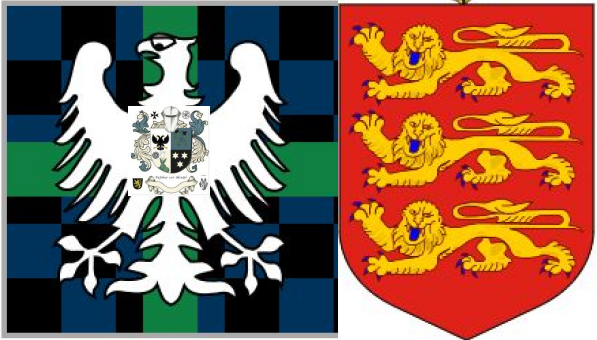
Blondel of the Nordic Channel Islands Guernsey Est. 1179 George Mentz
Bio -
George Mentz Noble Title -
George Mentz Ambassador - Order of the Genet
Knighthood Feudalherr - Fief Blondel von der Nordischen
Insel Guernsey Est. 1179 * New York Gazette ®
- Magazine of Wall Street - George
Mentz - George
Mentz - Aspen Commission - Ennerdale - Stoborough - ESG
Commission - Ethnic Lives Matter
- Chartered Financial Manager -
George Mentz
Economist -
George Mentz Ambassador -
George Mentz - George Mentz Celebrity -
George Mentz Speaker - George Mentz Audio Books - George Mentz Courses - George Mentz Celebrity Speaker Wealth
Management -
Counselor George Mentz Esq. - Seigneur Feif Blondel - Lord Baron
Longford Annaly Westmeath
www.BaronLongford.com * www.FiefBlondel.com |

Commissioner George Mentz - George
Mentz Law Professor - George
Mentz Economist
George Mentz News -
George Mentz Illuminati Historian -
George Mentz Net Worth
The Globe and Mail George Mentz
Get Certifications in Finance and Banking to Have Career Growth | AP News