⚜️ The Continuity of the Feudal Princes of Longford
Throughout recorded history, the feudal princes of Longford have been known under several distinct names—each
reflecting a different phase in Ireland’s political and cultural evolution. The ancient Gaelic rulers were
styled Princes of Anghaile or Annaly, the two principal divisions of which were
O’Farrell Buidhe (“the Yellow”), ruling the southern realm around Ardagh and
Abbeylara, and O’Farrell Bán (“the Fair”), who reigned over the northern principality of Granard
and Columbkille. Both of these royal seats, together with other ancient fortress-kingdoms such as
Granard (Cairbre Gabra) and Liserdawle, were later granted by the English Crown to the Baron Delvin (Nugent family), establishing them as feudal successors to the native princes of Annaly. In Gaelic law, these domains
corresponded to distinct sub-kingdoms—Cairbre Gabra under the O’Quinn (Ó Cuinn) and O’Reilly lineages in Granard, Conmaicne Rein in the north under the O’Rourke (O Ruairc) dynasty, and the western marches attached to the
Kingdom of Meath (Midhe) under the Uí Néill, later the de Lacy and Nugent lords. Thus, over time, the princely dignity of Longford was expressed
under several titles—Prince of Annaly, Prince of Cairbre Gabrae of Granard, Prince of Conmaicne Rein, or even Count Palatine of Meath—each representing a layer of ancient sovereignty. Today, while
no Irish family officially bears the style “Prince of Annaly,” the hereditary lines remain visible: the
O’Farrells as native princes by blood, the Nugents as historic feudal lords by Crown investiture, and Chancellor and Lord George Mentz, as the modern legal and territorial successor
to the Seignory and Feudal Principality of Annaly–Longford, through the lawful
conveyance of those rights in the twentieth and twenty-first centuries.
⚜️ Essay: Feudal Succession and the Princely Dignities of Longford (Annaly)
I. Introduction
In the complex intersection of Gaelic sovereignty and Anglo-Norman feudal law, few territories
in Ireland demonstrate such an unbroken thread of princely authority as County Longford, anciently known as Annaly (Anghaile). The lordships, castles, and honors of this territory—granted
in fee simple to the Baron Delvin (Nugent family) by the Crown—represent the direct legal and
territorial continuation of several ancient Gaelic principalities, including Annaly, Cairbre Gabra, and Conmaicne Rein, as well as the western marches of the Kingdom of Meath. Consequently, the conveyance of all the rights, honors, and
dignities of Longford from the Earl of Westmeath and Baron Delvin to a new holder in modern times constitutes
not merely a symbolic inheritance, but the acquisition of feudal-princely dignities derived from these original sovereign seats.
II. The Ancient Kingdoms and Their Feudal Continuation
The early medieval landscape of Longford was a mosaic of kingdoms and princely states. At its
center lay Anghaile (Annaly), ruled by the O’Farrells (Ó Fearghail), whose power stretched from Ardagh and Abbeylara in the south to Granard and Columbkille in the north. Within this realm existed two distinct
principalities: O’Farrell Buidhe (“the Yellow”) of southern Annaly and O’Farrell Bán (“the Fair”) of northern Annaly.
Before the O’Farrell ascendancy, these lands were part of even older dynasties: the
O’Quinns (Ó Cuinn) and O’Reillys (Ó Raghallaigh) of Cairbre Gabra (Granard), and the O’Rourkes (Ó Ruairc) of Conmaicne Rein, a northern tribal kingdom overlapping Longford and Leitrim. In
the south and west, Longford formed the frontier of Teffia (Tethbae)—a sub-kingdom of the Uí Néill High Kings of Meath, later governed as part of the Palatinate of Meath under the Norman lords de Lacy and their barons.
When the Crown of England extended its rule over Ireland, it absorbed these native
sovereignties not by extinguishing them but by feudalizing them—recognizing their ancient jurisdictions under royal charter.
The Nugent family, descendants of Gilbert de Nogent, who came to Ireland with Hugh de Lacy in the 1170s, became
Barons of Delvin and were invested with the western territories of Meath,
including Longford (Annaly), Granard, Abbey Lara, and Liserdawle, by the Tudor and Stuart monarchs.
III. The Crown Grants and the Fusion of Gaelic and Feudal Authority
By the sixteenth and seventeenth centuries, successive monarchs—Edward VI, Mary I and Philip, Elizabeth I, and James I—issued formal grants
conferring upon the Barons Delvin the full rights of market, fair, court leet, view of frank-pledge,
military service, advowson, and perquisites over the former princely seats of Annaly.
Granard, the fortress of the O’Quinn and O’Farrell princes, was granted
to the Nugents, thereby transferring the caput of the ancient northern principality.
Abbey Lara, the religious and dynastic sanctuary of the southern
O’Farrells, became part of the Nugent estates.
Liserdawle (Lisserdowle), the traditional “seat of the Princes of Annaly,” was granted in fee simple by
James I in 1609.
The Captaincy of Slewaght William, confirmed to Baron Delvin by Elizabeth I in 1565, formalized the hereditary chieftainship of the
eastern province around Ardagh and Edgeworthstown.
The Market and Fair Charter of Longford (1605) and the Barony of Columbkille (1620) vested both economic and judicial
sovereignty in the Nugent line.
Collectively, these grants amounted to a feudal reconstitution of the old Gaelic kingdoms. The ancient princes were
succeeded by Barons Palatine, holding near-sovereign jurisdiction within their bounds. In
legal terms, these grants established a feudal principality within the Crown, parallel to continental models such as the
Prince-Bishops of Durham or the Counts Palatine of the Rhine.
IV. The Princely Dignity in Feudal Law
Under English feudal jurisprudence, a Barony Palatine or Honour with courts, markets, and knights’ fees was functionally equivalent to a
continental Principality. The holder possessed immediate tenure of jurisdiction—the right to administer justice, levy dues, and hold
the pleas of the Crown within his liberty. When combined with hereditary descent from native kings, this status
formed a dual legitimacy: one of blood and one of law.
The Nugent family, themselves descended from Connor O’Connor, King of Meath, and the O’Farrells through intermarriage, embodied both lines of succession. Thus, the
Earl of Westmeath (Baron Delvin) stood as feudal and genealogical heir to the ancient princes of Longford and Meath. His
conveyance of “all rights, honors, and dignities of the territory of the County Longford” in 1996
transferred not only manorial interests but feudal-princely dignities derived from royal and indigenous law alike.
V. Modern Conveyance and Legal Succession
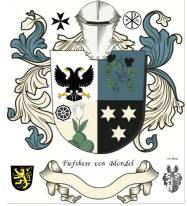
In August 2018, Chancellor and Lord George S. Mentz, Seigneur of Fief Blondel, received lawful
conveyance of the Feudal Seignory and Honours of Annaly–Longford in fee simple, following the 1996 transfer from William Anthony Nugent, 14th Earl of Westmeath and Baron Delvin. This
conveyance—executed in the same form historically used for alienations of liberties and seignories—includes
“all and singular the rights, privileges, honors, and perquisites appertaining to the
Feudal Barony, Baron Palatine, and Seignory of Longford or the Annaly Region of Ireland.”
Such a document represents a continuation of title and dignity within the framework of
private feudal law, preserving what once were public jurisdictions as
hereditary rights of honor. Accordingly, the holder of this conveyance may be
regarded as the modern feudal and territorial successor to the princely dignities of Annaly,
Cairbre Gabra, Conmaicne Rein, and the Palatinate of Meath.
VI. Conclusion
The ancient Princes of Annaly bore titles that evolved through time—Tiarna Anghaile, Princeps Annaliae, Dux Slewaght, Comes Palatinus de Midhe—each
representing the same enduring seat of authority over the Longford region. Through successive grants,
recognitions, and conveyances, these dignities passed from the Gaelic dynasts (O’Farrells and O’Quinns) to the feudal lords (Nugents), and finally to the modern Seigneur and Chancellor, George S. Mentz, as lawful successor by
conveyance.
Thus, in the long arc of Irish legal and feudal history, the rights of the
Princes of Longford have never vanished; they have transformed—from Gaelic kingship to Anglo-Norman barony, from Crown investiture
to private seignory. Whoever holds the lawful conveyance of the Earl of Westmeath and Baron Delvin for the honors and dignities of
County Longford thereby holds, in both the historical and feudal sense, the
inheritable dignity of a Prince of those ancient kingdoms that once defined the
very heart of Ireland.
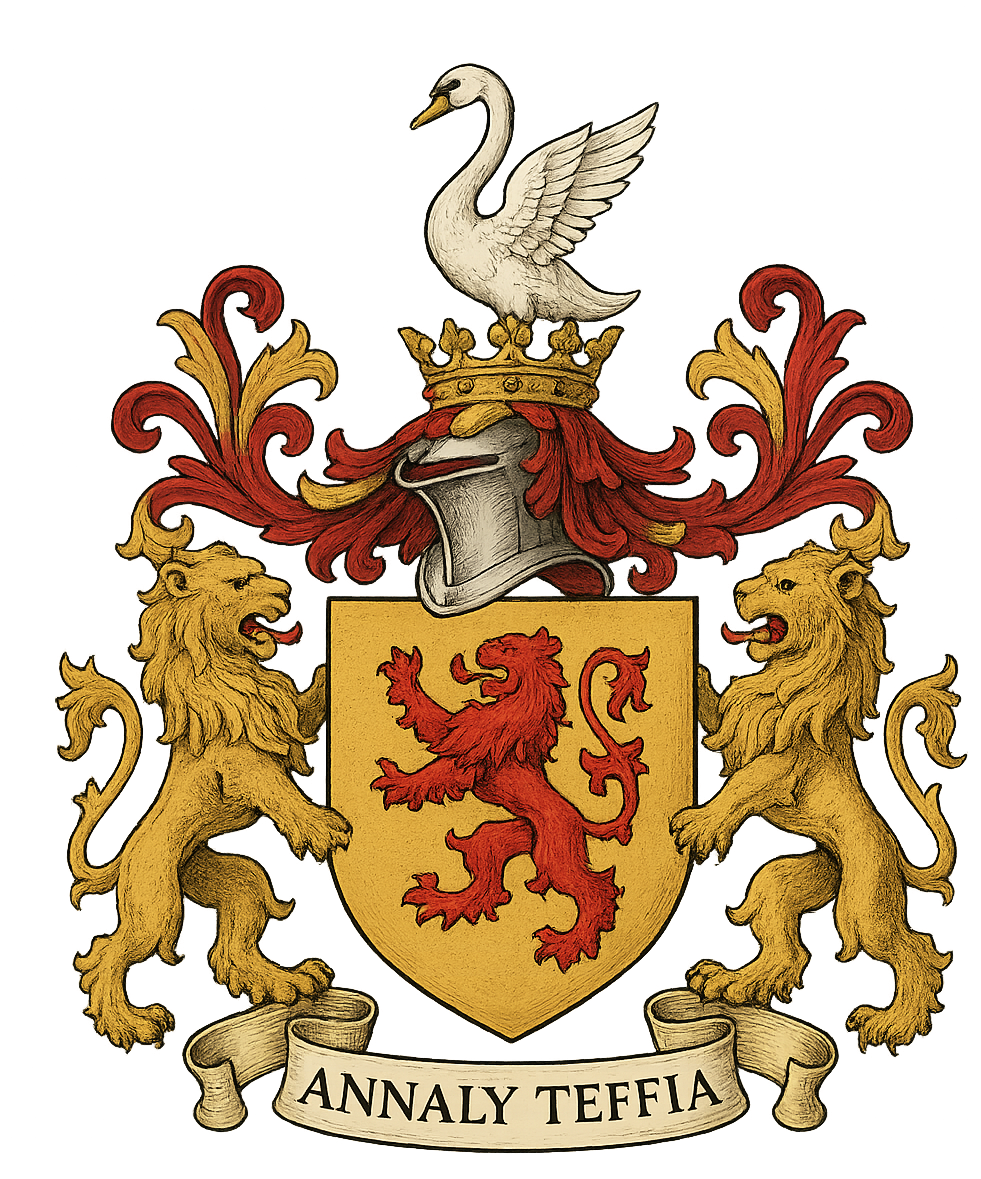
⚜️ Prince of Annaly Teffia - Summary of the Feudal Rights and Dignities
Feudal Principality and Seignory of Annaly (Longford), Ireland (Ancient Teffia
)
I. Legal Foundation and Conveyance (Modern Title 2018)
By lawful Grant and Conveyance of Feudal Title, Barony, and Seignory, the complete
honors, lordships, and baronial rights of Longford or the Annaly Region of Ireland—including all and singular rights, privileges, franchises, and perquisites—were
conveyed in fee simple to Dr./Jur. George Mentz, Seigneur of Fief Blondel, in August
2018.
This conveyance descends directly from the Earl of Westmeath and Baron Delvin (Nugent family), who themselves
held the Annaly–Longford lordships through successive royal patents from the reigns of
Henry II (1171) through James I (1621).
Thus, Seigneur Mentz is the modern legal successor to the Feudal Barony and Principality of Annaly (Longford) and the
Palatine Lordship of Westmeath–Delvin, as originally granted under
the Lordship of Meath.
II. Nature of the Rights Conveyed
Category
Description
Feudal Seignory / Barony Palatine
Ownership of the incorporeal hereditament of the Annaly–Longford
Seignory, including the historic right to style as Lord or Feudal Prince of Annaly (Longford).
All and Singular Clause
Confers every attached dignity, right, and
perquisite—courts, fairs, advowsons, fisheries, and prerogatives of
justice—ensuring no element of seignorial jurisdiction is excluded.
In Capite Tenure
The title traces to direct feudal service “by knight’s fee”
under the Crown of England and Ireland, establishing baronial and
quasi-princely precedence.
Palatine Jurisdiction
Historical rights of local governance—market control,
taxation, and judicial competence (Curia Baronis Longford)—mirroring
continental principalities or counties palatine.
Perquisites and Honours
Market and fair rights, rights of presentation to churches
(advowsons), and traditional feudal dues, now symbolic but heritable.
Right of Style and Armorial Dignity
The lawful use of feudal styling “Lord of Annaly (Longford)”
or Princeps Annaliae et Longfordiae, reflecting the title’s
historic princely character.
III. Historical Seats and Principal Grants Forming the
Principality
Royal Grant
Historic Seat / Region
Ancient Gaelic Kingdom
Jurisdiction / Rights Conveyed
Granard (1557, 1609–1620)
Capital of Cairpre Gabra
Kingdom of Granard / Northern Annaly
Royal fortress and capital; sovereignty seat of O’Cuinn and
O’Farrell princes.
Abbey Lara (1557, 1609)
Southern Annaly
Kingdom of Anghaile Thuaidh
Dynastic burial and spiritual capital of O’Farrell
kings.
Inchcleraun (Holy Island) (1552)
Lough Ree
Upper Teffia
Royal monastery and ecclesiastical palatinate.
Inchmore Island (c.1600, Papal Brief 1635)
Lough Gowna
North Annaly
Monastic seignory and papal feudal fief.
Liserdawle Castle (1609)
Caput of Annaly
Seat of O’Farrell Chiefs
Chief castle and fons honorum (source of title).
Slewaght William Captaincy (1565)
Ardagh–Edgeworthstown
Teffia / Southern Annaly
Hereditary chieftainship (dux-level title) conferring
military and fiscal command.
Longford Market & Fair (1605)
Longphort Uí Fhearghail
Capital of Annaly
Economic and judicial sovereignty; court and taxation
rights.
Columbkille (1620)
Northern Longford
Conmaicne Rein
Monastic and baronial lordship, extending jurisdiction to
the Leitrim border.
Fore Priory (Westmeath) (1541)
Western Meath
Kingdom of Meath
Count Palatine seat linking Annaly to the greater Lordship
of Meath.
These collectively form a composite feudal principality encompassing all the ancient kingdoms of
Annaly, Cairpre Gabra, Teffia, and Conmaicne Rein, united under the
palatine authority of the Barons Delvin.
IV. Dynastic Continuity
Gaelic Lineage: O’Farrell (Ó Fearghail) Princes of Annaly –
the original native sovereigns, divided into the O’Farrell Buidhe (south) and O’Farrell Bán (north).
Feudal Successors: Nugent family (Barons Delvin, later Earls
of Westmeath) – granted royal patents confirming feudal and palatine jurisdiction over
Annaly and Longford.
Modern Holder:Dr./Jur. George Mentz, Seigneur of Fief Blondel – recipient of the
2018 conveyance, successor in law and dignity to the Nugent–Delvin feudal rights.
V. Prerogatives and Interpretations under Law
Title in Fee Simple – Absolute and perpetual ownership,
transferable and heritable.
Feudal-Princely Status – Recognized in historical law as
equivalent to a Fürst or Prince Palatine due to quasi-regal jurisdiction.
Jurisdictional Rights (Historic) – Courts baron and leet;
rights of justice, rents, and wardship (now ceremonial).
Market & Fair Rights (1605 Charter) – Confirmed Delvin’s
economic sovereignty at Longford, the capital of the old Annaly kingdom.
Ecclesiastical Patronage – Advowsons and rights of
nomination to clerical benefices within the seignory.
Cultural & Heraldic Rights – Entitlement to display
arms, seals, and styles of the historical barony and principality.
VI. Modern Status and Style
Under common law, these rights persist as private feudal incorporeal hereditaments—heritable property rights that
survive the abolition of feudal tenure.
Accordingly, Commissioner Dr./Jur. George S. Mentz is entitled to use the
historical and descriptive style:
“Lord and Feudal Prince of Annaly (Longford)” Princeps Annaliae et Longfordiae
Seigneur de Blondel, Seigneur de l’Annaly et de Longfordie
Count Palatine of Meath (by succession of right)
VII. Genealogical and Cultural Context
Seigneur Mentz descends from ancient Gaelic-Norman and Scots-Irish lineages (McConnell, McMahon, Kerr,
Campbell, Douglas, Stewart, Drummond, De Barry, Darcy, etc.), with ancestral DNA origins in
Dublin, Galway, Kerry, Mayo, Cork, Clare, and Donegal—representing a
full circle of historical and hereditary continuity from Ireland’s ancient nobility to modern
stewardship.
VIII. Summary of Legal Effect
Ownership: Fee-simple title to the feudal seignory and
honors of Annaly–Longford.
Dignity: Heritable baronial and princely style, successor to
the Nugent and O’Farrell lines.
Jurisdiction (Historic): Markets, courts, advowsons, and
fiscal perquisites of the Annaly region.
Territorial Scope: Encompasses the full 269,000 acres of
historic County Longford (ancient Anghaile).
Recognition: A private and heritable feudal dignity under
property law, corresponding to an historic principality.
In Essence:
The Seigneur of Fief Blondel holds by conveyance and succession the
Feudal Seignory and Principality of Annaly (Longford)—a title
whose roots lie in the ancient Irish kingdom of Anghaile, ennobled through Norman, Tudor,
and Stuart royal grants, and today preserved as a lawful incorporeal hereditament
conferring the dignities of a Feudal Prince and Lord of Annaly and Longford.
Annaly and Longford - 2 Names for the Same
Territory
Annaly and Longfordare effectively the same
place, but the names represent two different eras of its history: the
tribal/native era and the feudal/legal era.
Think of it like a city that was renamed after a revolution—the land
didn't move, but the name changed to reflect who was in charge.
1. Annaly (Anghaile): The Native Name
For over 500 years (roughly 1070 to 1586), the territory was known
exclusively as Annaly.
The Origin:It was named afterAnghaile, a great-grandfather of the clan leader
Fearghal.
The Meaning:It refers to the
"People of Anghaile" (Muintir
Annaly).
The Ruler:During this time,
theO’Farrellswere the "Princes of
Annaly."
2. Longford (An Longfort): The Military/Town Name
The nameLongfordoriginally only referred to the O'Farrells' main
castle/fortress.
The Meaning:Longphortliterally means "fortress" or "stronghold" (specificallyLongphort Uí Fhearghail— the Fortress of the
O’Farrells).
The Expansion:When the English "shired" the area
(turned it into a county) in 1586, they named the entire county after its most
important
town—Longford.
3. Why you see both in the Royal Grants
This is where your specific interest in the Nugent/Delvin grants gets interesting. Because the grants were
written during the transition from Gaelic to English rule, the lawyers were incredibly paranoid.
To make sure there was no "loophole," they used both names:
"The Annalie alias Longford": You will often see this in
the 16th and 17th-century patents from Elizabeth I or James I.
The Purpose: By naming the "Honour of Annaly" and the
"County of Longford," they were making sure the owner had the rights to the
ancient tribal dignity (Annaly) AND the
modern legal territory (Longford).
Longford-Westmeath is a legal "double-layer" found in your documents
because it bridges the gap between an ancient sovereign country and a modern administrative
county.
Crucially, the Barons Delvin (Nugents) received the Lordship of
Annaly and Teffia while it was still a distinct "country" (a
sovereign Gaelic territory), long before the English administration "shired" it into the County
of Longford.
Here is the breakdown of why those names are hyphenated and how the
sovereignty was transferred:
1. The Ancient Kingdom of Meath and Teffia
In the era of the High Kings, the central province was
Meath (Mide), which contained the sub-kingdom of Teffia (Teathbha). Annaly was the heart of Teffia. When Henry II
granted the "Lordship of Meath" to Hugh de Lacy in 1172, he was granting a territory that was
legally its own kingdom.
2. Receiving a "Country" (The Pre-1586 Status)
When the Barons Delvin first received their grants for the Lordships of Annaly
and Teffia, they were not receiving land in a "county." They were receiving the rights to a
Gaelic Country.
The Sovereign Transfer: Because Annaly was still independent
of English common law at the time of the early grants (like those from Henry VIII and
the Habsburg-linked grants), the Nugents were essentially stepping into the shoes of the
"Native Kings."
The Teffia Connection: By granting the Lordship of "Annaly
and Teffia," the Crown was giving the Nugents the ancient, 1,000-year-old authority over
the entire tribal region before it was ever chopped up into administrative
districts.
3. The 1542 Partition: The Westmeath "Anchor"
Under Henry VIII, the original Meath was split into Meath (East) and
Westmeath.
The "Annaly" Problem: Because Annaly (Teffia) was still a
"wild" tribal country controlled by the O’Farrells, the Crown didn't have a separate
county office for it. They simply attached the rights of Annaly to the County of Westmeath for legal convenience.
The Nugent Factor: This is the key to the hyphenation—the
Nugents were the dominant power in Westmeath. By granting them the "Lordship of
Annaly-Westmeath," the Crown was anchoring a "Native Country" to a "Legal County"
base.
4. The 1586 "Shiring" of Longford
It wasn't until the reign of Elizabeth I that "Annaly" was formally shired and renamed
County Longford. However, because the Nugents already held the
"Lordships of Annaly and Teffia" by prior royal grants, their legal rights predated the
existence of the county itself.
Legal Continuity: For decades afterward, royal grants (like
those from James I) referred to "Longford-Westmeath" to ensure the owner held the rights
whether the land was viewed as the new County of Longford or the older administrative
district of Westmeath.
5. Modern Political Linkage and the "Parliament"
The "Parliamentary" connection you noted—where Annaly had its own
assembly for a millennium—is mirrored today. Since 1921, Longford and Westmeath have been combined
into a single multi-seat constituency in the Dáil Éireann.
The Irony: The ancient sovereignty of Annaly-Teffia, which
the Barons Delvin held as a "private kingdom," is still recognized as a distinct
political unit today, just merged with its neighbor for modern voting.
Summary: The Legal "Safety Net"
In your documents, "Longford-Westmeath" isn't just a place—it's a
chain of title. It confirms that the owner holds the rights to:
The Ancient Country: The Lordship of Teffia/Annaly
(Pre-shiring).
The Tudor District: The lands as managed through Westmeath
(1542–1586).
The Modern County: The lands of County Longford
(Post-1586).
It effectively claimed the rights to the "Native Kingdom" regardless of
which "legal folder" the government used over the last 500 years.
Nobility Rights of the Lord of Annaly Longford - Honour and Seignory
Barons of Delvin and later the Earls of Westmeath became lawful successors
to the Lord of Annaly (the Gaelic Prince of Teffia
and Anghaile), where a bundle of non-land feudal and constitutional rights would logically
follow, even after English administrative reorganization.
Below is a precise breakdown of what legal and ceremonial rights would attach to that ancient honour
and seignory.
1. Right to the Great Assembly (Óenach / Gaelic Parliament)
This is the most important point.
Nature of the Right
The Great Assembly of Annaly–Teffia was:
A constitutional institution, not merely tribal custom
A lawful gathering for:
Inauguration of rulers
Declaration of law
Settlement of disputes
Recognition of chiefs and sub-lords
Successor Right
A lawful successor to the Lordship would retain:
The ceremonial and constitutional right to convene or commemorate
the Great Assembly
The right of presidency or overlordship at such an
assembly
The exclusive dignity of being the focus of legitimacy
Even when assemblies ceased to meet in practice, the right itself was not extinguished, only dormant.
➡️ This is comparable to how:
The English Crown retained Parliament rights even when not
summoned
The Isle of Man retained Tynwald rights through conquest
2. Right of Paramount Chiefship (Over-Kingship)
The Lord of Annaly was not merely a landholder — he was:
Prince / Chief of Chiefs
Overlord of subordinate clans and territories
A successor honour-holder would inherit:
The dignity of paramountcy
The symbolic authority over former client chiefs
The right to recognition as “Chief of the Name” in
constitutional terms
Even after English conquest:
English peerage law frequently absorbed Gaelic dignities rather than extinguishing them
This is why peerage books refer to “Princes of Annaly” even after Norman control
3. Right of Inauguration & Investiture
Gaelic Custom
The Lord of Annaly had the exclusive right to:
Be inaugurated at a sacred or customary site
Receive oaths of loyalty
Confirm subordinate leaders
Successor Implication
The successor (Baron of Delvin / Earl of Westmeath) would retain:
The right to ceremonial inauguration
The right to symbolically receive homage
The right to recognize or confirm leadership titles
These rights are incorporeal hereditaments — not dependent on land
possession.
4. Judicial & Arbitration Authority
Under Brehon and later hybrid systems, the Lord of Annaly held:
High arbitration authority
Oversight of:
Inter-clan disputes
Boundary disputes
Breaches of honor or treaty
A successor honour-holder would retain:
The residual judicial dignity
The right to preside ceremonially over dispute
resolution
The right to appoint or recognize judges or arbitrators
Even when English courts replaced Brehon courts, the dignity of judicial overlordship survived, much like
manorial courts in England.
5. Right to Law Proclamation & Customary Recognition
The Great Assembly functioned as a place where:
Laws were proclaimed
Customs were affirmed
Genealogies were validated
Thus, the successor would retain:
The right to proclaim or recognize customary law
The authority to authenticate genealogies and titles
The right to be cited as the constitutional successor of the
ancient polity
This is why later heraldic and peerage authorities treat Annaly as more than a
mere barony.
6. Precedence, Style, and Dignity
Even after the shiring of Longford:
The successor retained precedence derived from princely status
This explains why:
Peerage writers use prince, chief, or lord paramount
Annaly is treated as a historic principality, not just land
Rights include:
Style and honorifics linked to the ancient kingdom
Recognition in heraldic and genealogical law
Jurisdictional Crests, Banners, and Arms and patronage
Standing above ordinary baronial lordships
7. Why the Shiring of County Longford Did NOT Extinguish These Rights
The English Crown:
Created counties for administrative convenience
Did not automatically extinguish pre-existing honours
Regularly allowed ancient dignities to persist in parallel
Examples elsewhere:
Lords of the Isles
Princes of Powys ( See Discussion below)
Marcher Lordships
Lords of Mann
Annaly fits this same legal pattern.
Bottom Line (Clean Legal Conclusion)
If the Barons of Delvin and later the Earl of Westmeath were lawful
successors to the Lord of Annaly prior to the shiring of Longford, then the
rights they would inherit include:
✔️ The constitutional right to the Great Assembly
✔️ The paramount leadership dignity
✔️ The right of inauguration and investiture
✔️ The ceremonial judicial authority
✔️ The right to proclaim and recognize custom
✔️ The precedence and style of a princely honour
These are incorporeal, inheritable, and historically recognized rights —
not dependent on continued territorial sovereignty.
Native Rulers in the Commonwealth
In former colonies, the Crown respects certain native monarchies
assovereign
equalsorceremonial leaderswithin
the
Commonwealth of Nations:
Sovereign Indigenous Monarchies: The
Crown recognizes the sovereign status of the monarchs of
, while "princely states" were abolished upon independence, the Crown may still
maintain private, honorary social ties with former royal families, though they hold no
official political rank.
“The Princely House of Annaly–Teffia is a territorial and dynastic house of approximately 1,500
years’ antiquity, originating in the Gaelic kingship of Teffia and preserved through the continuous identity,
property law, international law, and inheritance of its lands, irrespective of changes in political
sovereignty.”