Honour of Annaly - Feudal Principality & Seignory Est. 1172


|

Baron of Moyashel - Part of the Longford SeignoryANCIENT FEUDAL WESTMEATH BARONIES AND BARON MOYASHEL
The legal, territorial, and political mechanics behind how the Nugents (Barons Delvin) systematically absorbed the earlier Norman rights of the Tuite family in Annaly, secured the strategic capitals of Granard and Longford, and how the Earldom of Westmeath (1621) impacted these existing rights are rooted in standard feudal practices. 1. Logic of Delvin Inheriting Tuite Lands & Rights in AnnalyThe transition of feudal claims and landholdings from the Tuites (Lords of Granard and Barons of Moyashel) to the Nugents (Barons Delvin) followed a clear strategic and legal progression: A. Dynastic Marriage & Inter-Baronial InheritanceIn medieval Ireland, Anglo-Norman baronial lines frequently merged through heiress marriages. The Tuite family—who had originally been granted Granard and Moyashel by Hugh de Lacy around 1199–1210—suffered several line fractures and forfeitures over generations. Through strategic intermarriage (most notably between the Nugent, Tuite, and Marward lineages), rights to former Tuite fiefs, manors, and advowsons were systematically transferred to or claimed by the Barons Delvin. B. Geopolitical "Buffer Zone" Strategy (Crown Policy)During the 14th–15th-century Gaelic Resurgence, the O'Farrells had largely pushed the Tuites out of Annaly. When the Tudor Crown systematically re-established royal control in the 16th century via Surrender and Regrant and the dissolution of the monasteries, the English administration needed a strong, loyal, Pale-based lord to secure the vulnerable western border of Meath/Westmeath. Because the Tuites had lost effective military control over their historic grants in Annaly, the Crown consolidated those dormant/forfeited feudal claims and regranted them directly to the Baron Delvin, who possessed the military capacity to enforce Crown authority along the Annaly frontier. C. Dissolution of Monastic Estates (1540–1557)Much of the Tuite family's early wealth and legal presence in Annaly was bound up in religious foundations—most notably Abbeylara (Abbey Lerha), founded by Richard de Tuite in 1205.
2. Crown Grants of Granard and Longford (The Two Capitals)Annaly was traditionally divided into two spheres of authority: North Annaly (centered on Granard) and South/Central Annaly (centered on Longford/Lisserdowling). By acquiring both, Lord Delvin obtained full legal and feudal dominion over the entire region.
Granard (North Annaly Caput)
Longford & Lisserdowling (South Annaly Caput)
3. How the Elevation to the Earldom (1621) Affected Existing GrantsOn November 22, 1621, King James I elevated Richard Nugent, 15th Baron Delvin, to 1st Earl of Westmeath. This creation had profound effects on the pre-existing grants in Annaly: A. Consolidation of Dignities (Barony Subsumed into Earldom)The elevation did not cancel, void, or alter any of the existing land grants, manorial privileges, or charters previously given to Baron Delvin. Instead, the ancient Barony of Delvin and its associated liberties inside Annaly/Longford were legally subsumed under the higher comital rank. The Earls of Westmeath continued to hold their Longford estates under their primary baronial titles as Baron Delvin. B. Elevation of Territorial JurisdictionPrior to 1621, Delvin held his lands in Annaly as a series of distinct, individual grants in capite (direct from the Crown), monastic patents, and manorial charters. The Earldom created a unified regional dignity that bound the Lordship of Delvin (in Westmeath) with the Seignory/Honour of Annaly (in Longford) under a single higher feudal title. C. Interactions with the Plantation of Longford (1615–1620)Right before the creation of the Earldom, the Crown conducted the Plantation of Longford. During this process:
Here is the revised history. It specifically details how the Barons Delvin (Nugents) systematically absorbed the feudal rights of the Tuites—a process that resulted not only in acquiring both capitals of Annaly (Granard and Longford), but also in inheriting the Feudal Barony of Moyashel as a major territorial byproduct.
Strategic Mechanics of the Tuite Absorption & Moyashel
1. How Moyashel was Inherited as a ByproductWhen Hugh de Lacy divided the western March of Meath around 1172–1200, Richard de Tuite received the Feudal Barony of Moyashel (located in modern central Westmeath around Mullingar/Killucan) as well as the frontier grant of Granard in North Annaly. During the 13th and 14th centuries, the senior line of the Tuite family experienced several generational failures of direct male heirs, leading to property divisions and heiress claims. Through early intermarriages between the Nugent, Tuite, and FitzJohn lines:
2. Legal Transfer of the Capitals: Granard & Longford
3. Impact of the Earldom of Westmeath (1621)When Richard Nugent was elevated to 1st Earl of Westmeath in 1621, his existing feudal holdings were affected in three ways:
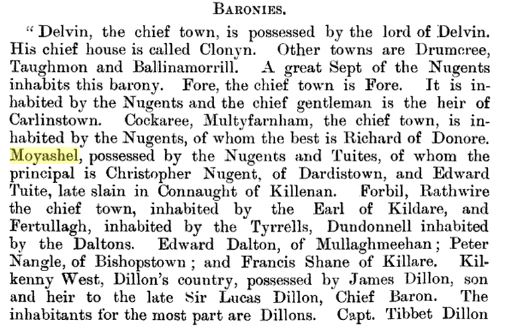
"Delvin, the chief town, is possessed by the lord of Delvin. His chief house is called Clonyn. Other towns are Drumcree, Taughmon and Ballinamorrill. A great Sept of the Nugents inhabits this barony. Fore, the chief town is Fore. It is inhabited by the Nugents and the chief gentleman is the heir of Carlinstown. Cockaree, Multyfarnham, the chief town, is inhabited by the Nugents, of whom the best is Richard of Donore. Moyashel, possessed by the Nugents and Tuites, of whom the principal is Christopher Nugent, of Dardistown, and Edward Tuite, late slain in Connaught of Killenan. Abbeylaragh or Granard, Co. Longford, was founded in 1214 by Richard Tuite, Baron Palatine of Moyashel. In 1315 Edward Bruce burned the town and despoiled the abbey. In this place a monastery had already been founded by St. Patrick. Edward Aloysius Pace - 1922 - Read - More editions REFERENCE Risteárd de Tiúit (anglicised as Richard Tuite) (ob. 1210) was a member of Richard de Clare, 2nd Earl of Pembroke's Irish invasion force, and Lord Chief Justice of Ireland. His part in the original invasion is acknowledged in The Song of Dermot and the Earl, which recorded his grant of land in the western part of Meath (present-day Westmeath and Longford) under the authority of Hugh de Lacy in Trim. [1]
The county of Meath was given by his Majesty to Sir Hugh de Lacie, to hold of the Crown by Knight's service, and Sir Gilbert de Nogent marrying his sister Rosa,obtained with her as a marriage portion, the Barony of Delvin, (except the village of Torrochelack, belonging to the Abbot of Foure,) which large tract of lands he distributed amongt his brothers and others. He died JnJ[202, without issue surviving, having had two sons, Adam and Hugh, who both deceased without issue, during the life time of their father. Richard, the second brother, succeeded, whose only daughter and heir married Richard le Tuit, who became, jure uxoris, third Baron of Delvin. He was father to John le Tuit, fourth Baron of Delvin, whose son, Richard Fitzjohn le Tuit, fifth Baron, married Eglantina Dewswell, and was father of Thomas Fitzjohn, sixth Baron ; he dropped the name of le Tuit, and his son, Richard Fitzjohn, seventh Baron, was father of John Fitzjohn, eighth Baron Delvin, whose only daughter and heir, Catherine, married Sir William Nugent in 1407, (8th of Henry IV.,) descended from Sir Christopher, son of Sir Gilbert Nugent. He, jure uxoris, became ninth Baron Delvin. Thus the honors remained in the family of Tuit, or Tuite, for one hundred and twenty years. By his wife Catherine he had issue.
1552 Grant of AbbeyLara -
The Cistercian Abbey in 1552 To Richard Nugent Baron Delvin. The AbbeyLara was probably founded in
c.1210
^ La Chanson Dermot e le Conte: 'De huge de laci vus conterai, Cum il feffa ses baruns, Cheualers, serianz e garsunz. Chastelknoc tut premer donat, A huge tÅ·rel, kil tant amat; E chastel brec, solum lescrit, A barun willame le petit, Macherueran alter si, E la tere de rathkeuni; Le cantref pus de hadhnorkur, A meiler, qui ert de grant valur, Donad huge de laci, Al bon meiler le fiz herui; A gilbert de nangle en fin, Donat tut makerigalin; A iocelin donat le nouan, E la tere de ardbrechan: Li vn ert fiz, li alter pere, Solum le dit de la mere; A richard tuit ensement, Donad riche feffement'. This extract from Maurice Regan's La Chanson Dermot e le Conte or 'The Song of Diarmaid and the Earl', written circa 1225AD and the most famous literary introduction to the Norman invasion translates thus: 'Of Hugh de Lacy I shall tell you, How he enfeoffed his barons, Knights, sergeants and retainers Castleknock in the first place he gave To Hugh Tyrrell, whom he loved so much; And the Castle Brack, according to the writing, To baron William le Petit, Magheradernon likewise And the land of Rathkenny; The cantred of Ardnorcher then To Meiler, who was of great worth, Gave Hugh de Lacy- To the good Meiler Fitz Henry; To Gilbert de Nangle, moreover, He gave the whole of Morgallion; To jocelin he gave the Navan, And the land of Ardbraccan, (The one was son, the other father, according to the statement of the mother); To Richard Tuite likewise He gave a rich fief', The Song of Dermot and the Earl: An old French Poem about the coming of the Normans to Ireland (From the Carew Manuscript No 596 in the Archiepiscopal Library at Lambeth Palace), ed. & trans. Goddard Henry Orpen (Clarendon Press, 1892, reprinted 1994)]
When Meath, the mensal demesne of the Irish kings, was erected into a Palatinate, this Richard became a Palatine peer, by the style ofBaron of Moyashell,a title which he transmitted to his posterity. He was killed in 1211, by the fall of a tower in Athlone, and buried in the Abbey near Granard, which himself had previously founded, and where he had also raised a frontier castle. Richard, his son, thereupon inherited the manors of Kilalton, Demar, and Kilster, as did his brother Maurice the lands of Lochlock, Sonnagh, Imper, Jordanstown, &c. To this Richard the custody of the Castle of Clonmacnois was committed in 1224, and in 1232 he marched, under the command of William de Lacy, into Upper Breffny, against the O'Reillys, by whose sept the invaders were defeated with much loss, Richard de Tuyt, and Simon de Lacy, being amongst the wounded. In 1244, he had military summons to a royal expedition against the Scots. His issue male becameextinctin the second generation.
The family of Nugent is descended from Nogent de Retrou, descended from the illustrious house of Bellesme, in Normandy, two brothers of which family, Gilbert and Hugh, accompanied William the Conqueror from Normandy, and were with him at the battle of Hastings. In the reign of Henry II. (1172), Sir Gilbert de Nogent, with his brothers, Richard, Christopher, and John, came in the expedition to Ireland in company with Sir Hugh de Lacy. The county of Meath, which at the period comprised Westmeath, or the ancient kingdom of Meath, was given by his Majesty to De Lacy, to hold to the Crown by Knight's Service, and Sir Gilbert de Nugent, marrying his sister, Rosa, obtained with her as her marriage portion the barony of Delvin (except the village of Torrelack, belonging to the Abbot of Fore), which large tracts of lands he distributed among his brothers and others.
He died in 1202 without issue surviving, having had two sons, Adam and Hugh, who both deceased without issue during the lifetime of their father. Richard, the second brother, succeeded, whose only daughter and heir married, Richard le Tuit, and carried the barony of Delvin into the family of John or James (supposed to be Tuite), into which she married, and it so remained until brought back by inter-marriage of Sir. Wm. Nugent, of Balrath, descended from Christopher Nugent, third brother of Sir Gilbert, with Catherine, daughter and heiress of John Fitzjames, Baron of Delvin. This Sir William was elected 10th November, 1401, Sheriff of Meath, by the county, in which office he was confirmed by the King for one year, again during pleasure, by patent, 21st Nov., 1402. He was succeeded at his decease by his eldest son, Richard, second Baron of Devlin, who, in consequence of his experiences and services in the King's wars, to the impoverishment of his fortune, had an order dated at Trim, 20th February, 1428, to receive 20 marks out of the Exchequer. This Nicholas married Catherine, daughter of Thomas Drake, sister and heiress of Nicholas Drake, lord of Drakerath, in the county of Meath, and was succeeded by his eldest son, James, third baron of Delvin, who married Elizabeth, elder daughter and co-heiress of Sir Robert Hollywood of the barony of Delvin, and grand-daughter, maternally, of Christopher, third lord of Killeen, and was succeeded by his eldest son, fourth baron of Delvin, who married the daughter of Sir Robert Preston, of Gormanstown, and was succeeded by his son, Sir Richard Nugent, Knight, .fifth baron of Delvin, who married Elizabeth, daughter of the Earl of Kildare, and was svicceeded by his son, Christopher, sixth baron, who was father of Richard, seventh baron, who had summonses to Parliament 1486. 1490. and 1491, and who was constituted by the Lords Justices and Council, 1496, Commander and Leader-in-Chief of all the forces destined for the defence of the counties of Dublin, Meath, Kildare and Louth, the strongholds of the English Pale. His lordship was subsequently summoned to Parliament in 1498, but failing to appear, he was fined 40s. for non-attendance.
In 1504, Lord Delvin, accompanied by the Earl of Kildare, went to the famous battle of Knocktough, in Connaught, and was the first to throw a spear into the ranks of the Irish, by which he chanced to kill one of the Burkes. The battle of Knocktough, or Knocktow, was fought on the 19th August, at a place called Cnock-Tuagh, which according to MacGeoghegan and others, signifies "the hill of the battle-axes," about seven or eight miles north-east of Galway. The circumstances attending the demolition of three castles belonging to Malachy O'Kelly, lord of Hy Maine, in Galway, is stated as the chief cause of this celebrated battle, but according to other accounts, various private quarrels and public jealousies between Gerald Fitzgerald, Earl of Kildare, then Lord Deputy of Ireland, and Ulrick MacWilliam Burke, lord of Clanricarde; in Galway.
12th Century: DE LACY ENFEOFFMENT │ Sir Richard de Tuite (1199/1205) - Builds Motte of Granard (1199) - Founds Cistercian Abbeylara (1205) │ 14th Century: GAELIC RESURGENCE - O'Farrells reclaim physical control │ 16th Century: TUDOR DISSOLUTION │ Crown Patents (1552–1557) to BARON DELVIN - 1552: Abbeylara & Monastic Lands granted in fee simple - 1557: Town, Castle Site, & Manor of Granard granted *in capite* |
About Longford Feudal Prince House of Annaly Teffia Rarest of All Noble Grants in European History Statutory Declaration by Earl Westmeath Kingdoms of County Longford Pedigree of Longford Annaly What is the Honor of Annaly The Seigneur Irish Roots of George Mentz Chronology of Teffia Annaly Lords Paramount Ireland Market & Fair Chief of The Annaly One of a Kind Title Lord Governor of Annaly Prince of Annaly Tuath Principality Feudal Kingdom Irish Princes before English Dukes & Barons Fons Honorum Seats of the Kingdoms Clans of Longford Region History Chronology of Annaly Longford Oldest Gaelic Kingdom Annaly Principality Nobility Law Normandy Hereditaments Captainship of Ireland Princes of Longford Holy Sites & Gods News Parliament 850 Years Grants in Six Baronies to Delvin Leadership Titles of Annaly Irish Free State 1172-1916 Feudal Princes 1556 Habsburg Grant and Princely Title Rathline and Cashel Kingdom The Last Irish Kingdom Landesherrschaft King Edward VI - Grant of Annaly Granard Spritual Rights of Honour of Annaly Principality of Cairbre-Gabhra House of Annaly Teffia 1400 Years Old Count of the Palatine of Meath Irish Property Law Manors Castles and Church Lands A Barony Explained Moiety of Barony of Delvin Nugents of Annaly Ireland Spiritual & Temporal Islands of The Honour of Annaly Longford Blood Dynastic Burke's Debrett's Peerage Recognitions Water Rights Annaly Property Law Writs to Parliament Irish Nobility Law Moiety of Ardagh Dual Grant from King Philip of Spain Rights of Lords & Barons Princes of Annaly Pedigree Abbeys of Longford Styles and Dignities Ireland Feudal Titles Versus France & Germany Austria Sovereign Title Succession Mediatized Prince of Ireland Grants to Delvin Lord of St. Brigit's Longford Abbey Est. 1578 Feudal Barons Water & Fishing Rights Clan Brehon Tribal Law Comparison Ancient Castles and Ruins Abbey Lara Honorifics and Designations Kingdom of Meath Feudal Westmeath Seneschal of Meath Lord of the Pale Irish Gods The Feudal System Baron Delvin Kings of Hy Niall Colmanians Irish Kingdoms Order of St. Columba Chief Captain Kings Forces Commissioners of the Peace Tenures Abolition Act 1662 - Rights to Sit in Parliament Contact Law of Ireland List of Townlands of Longford Annaly English Pale Court Barons Lordships of Granard Irish Feudal Law Datuk Seri Baliwick of Ennerdale Moneylagen Lord Baron Longford Baron de Delvyn Longford Map Lord Baron of Delvin Baron of Temple-Michael Baron of Annaly Kingdom Annaly Lord Conmaicne Baron Annaly Burke's and Debrett's Peerage Citations Order of Saint Patrick Baron Lerha Granard Baron AbbeyLara Baronies of Longford Princes of Conmhaícne Angaile or Muintir Angaile Baron Lisnanagh or Lissaghanedan Baron Moyashel Baron Rathline Baron Inchcleraun HOLY ISLAND Quaker Island Longoford CO Abbey of All Saints Kingdom of Uí Maine Baron Dungannon Baron Monilagan - Babington Lord Liserdawle Castle Baron Columbkille Kingdom of Breifne or Breny Baron Kilthorne Baron Granarde Count of Killasonna Baron Skryne Baron Cairbre-Gabhra AbbeyShrule Events Castle Site Map Disclaimer Irish Property Rights Indigeneous Clans Dictionary Maps Honorable Colonel Mentz Valuation of Principality & Barony of Annaly Longford Irish Noble Titles of Annaly Longford“The Princely House of Annaly–Teffia is a territorial and dynastic house of approximately 1,500 years’ antiquity, originating in the Gaelic kingship of Teffia and preserved through the continuous identity, property law, international law, and inheritance of its lands, irrespective of changes in political sovereignty.”
Feudal Baron of Longford Annaly - Baron Longford Delvin Lord Baron &
Freiherr of Longford Annaly Feudal Barony Principality Count Kingdom of Meath - Feudal Lord of the Fief
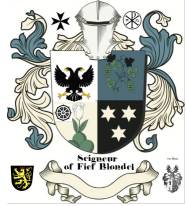
Blondel of the Nordic Channel Islands Guernsey Est. 1179 George Mentz
Bio -
George Mentz Noble Title -
George Mentz Ambassador - Order of the Genet
Knighthood Feudalherr - Fief Blondel von der Nordischen
Insel Guernsey Est. 1179 * New York Gazette ®
- Magazine of Wall Street - George
Mentz - George
Mentz - Aspen Commission - Ennerdale - Stoborough - ESG
Commission - Ethnic Lives Matter
- Chartered Financial Manager -
George Mentz
Economist -
George Mentz Ambassador -
George Mentz - George Mentz Celebrity -
George Mentz Speaker - George Mentz Audio Books - George Mentz Courses - George Mentz Celebrity Speaker Wealth
Management -
Counselor George Mentz Esq. - Seigneur Feif Blondel - Lord Baron
Longford Annaly Westmeath
www.BaronLongford.com * www.FiefBlondel.com |

Commissioner George Mentz - George
Mentz Law Professor - George
Mentz Economist
George Mentz News -
George Mentz Illuminati Historian -
George Mentz Net Worth
The Globe and Mail George Mentz
Get Certifications in Finance and Banking to Have Career Growth | AP News