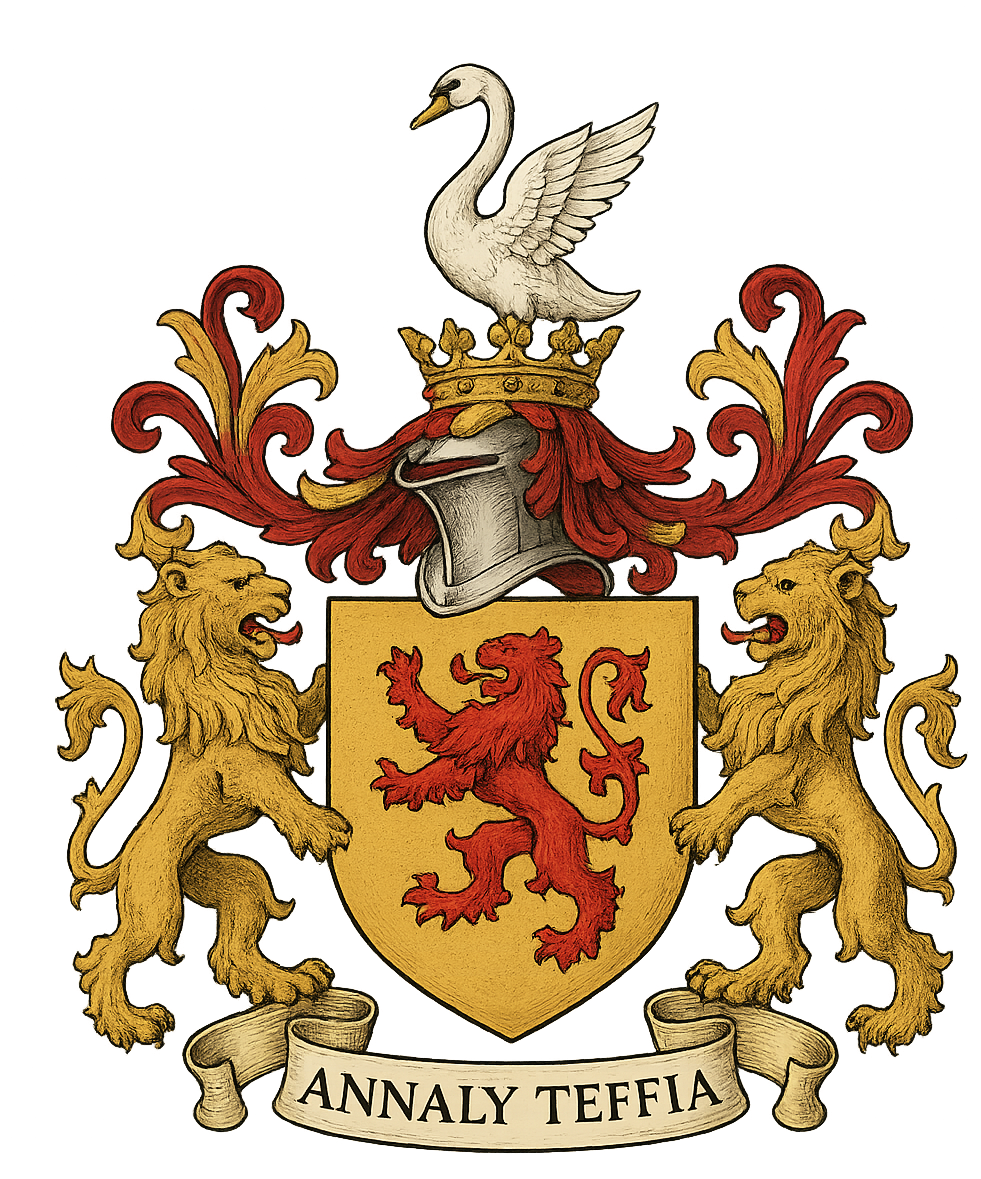
Honour of Annaly - Feudal Principality & Seignory Est. 1172


|

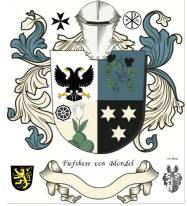
The MacDonnell–Nugent–Mentz Line: A Unified Historical NarrativeThe modern holder of the feudal rights of the Honour of Annaly, Commissioner George Mentz, Seigneur of Blondel, stands at the intersection of two powerful historical lineages. His position is not only based on legal acquisition of the Nugent-Westmeath feudal rights over Annaly/Longford, but also on genealogical descent from the ancient Gaelic rulers of the North: the McConnell/MacDonnell Clan of Antrim. George Mentz, Esq., Seigneur of Blondel, Lord of Stoborough, and Lord of the Bailiwick of Ennerdale, carries an ancestral heritage deeply rooted in the ancient Gaelic clans of Ireland and Scotland. His lineage reflects the enduring cultural and historical traditions of the Gaels—an indigenous people whose kinship networks, dialects, and warrior aristocracies shaped the Highlands, Islands, and western coasts of Ireland for over two millennia. Through his forebears, Mentz descends from the McConnell (Mac Domhnaill / Clan Donald), McMechan, McMahon, Fenton, and Fleming clans, each associated with territories that once formed the heartlands of the Gaelic world. These families emerged from regions now known as Counties Dublin, Mayo, Galway, Kerry, Donegal, Cork, and Clare—areas long recognized as strongholds of Gaelic identity, law, and custom. As a descendant of the Mac Domhnaill (McConnell) line—a branch of the famed Clan Donald—Mentz’s heritage connects to one of the most powerful dynastic houses of medieval Scotland and Ireland. The MacDonnells, like many Gaelic families, maintained lordships on both sides of the Irish Sea, blending Highland Scottish and Northern Irish identities. His ancestry also ties him to respected Scots-Irish families including Kerr, Douglas, Campbell, Stewart, Drummond, and Kirkpatrick, whose histories span the Hebrides, Ulster plantations, and the Scottish Borders. In Ireland, familial connections to Boyle, De Barry, Power, Darcy/D’Arcy, FitzGerald of Leixlip, FitzJohn Barry, MacCarthy Reagh, and Mac Fineere Donnel MacCarthy intertwine his lineage with both Norman-Irish and ancient Gaelic aristocracies. This multifaceted lineage reveals an extraordinary tapestry—Scottish, Irish, English, German, French, Italian, Egyptian, Sicilian, Anatolian, Dravidian, and Native American—demonstrating a depth of ancestral migration that crosses continents and civilizations. Yet, at its cultural center, Mentz’s heritage remains deeply indigenous to the Gaelic world of Ireland and Scotland, linking him directly to the clans, septs, and noble families who shaped the history, law, and identity of the Celtic West. Through this lineage, Counselor George Mentz, Esq. not only preserves the memory of his ancestors but also embodies the living continuity of Gaelic tradition—an inheritance rooted in clan leadership, territorial stewardship, and centuries-old customs that continue to resonate through his roles as Seigneur of Blondel and Lord of Ennerdale and Stoborough. Together, these two threads create a historically meaningful continuity between Gaelic princely heritage and Anglo-Norman feudal authority. 🔶 1. Feudal Rights Acquired from the Earl of WestmeathThe Nugent family, Barons Delvin and later Earls of Westmeath, held the Honour of Annaly (ancient Angaile/Teffia, now County Longford) for centuries under a series of royal grants, including:
These rights formed one of Ireland’s most enduring feudal jurisdictions. George Mentz formally acquired these historic rights and hereditaments from the Earl of Westmeath line, thereby becoming the modern successor to the feudal Seignory. 🔶 2. Gaelic Descent From the MacDonnells / McConnells of AntrimSeparate from his legal acquisition, George Mentz is also a direct descendant of the: McConnell / MacDonnell Clan of Antrim,a dominant branch of Clan Donald, descended from the Lords of the Isles. The MacDonnells of Antrim were:
Most importantly, they became linked to the Nugent line through the celebrated marriage of:
Because George Mentz descends from the McConnells/MacDonnells of Antrim, his ancestry intersects with the historic bloodlines connected to the Honour of Annaly. 🔶 3. The Convergence of Lineage and Seignory in George MentzFor the first time in centuries, both: ✔ the legal feudal rights of Annaly✔ the ancestral bloodline connected to its historical holdersare united in one person: **Commissioner George MentzSeigneur of Blondel This creates a historically significant synthesis: A. Gaelic Royal and Princely Bloodlinethrough the McConnells/MacDonnells of Antrim and Clan Donald. B. Anglo-Norman Feudal Authoritythrough the Nugent-Westmeath line whose rights Mentz legally acquired. 🔶 4. Modern Meaning of This UnionWhile the Republic of Ireland no longer recognizes titles of nobility, two forms of heritage remain: 1. Genealogical significanceDocumented descent from one of the oldest Gaelic princely houses. 2. Private legal heritageOwnership of the feudal hereditaments, rights, and historic seignory associated with the Honour of Annaly. This combination is exceptionally rare: a unification of bloodline legitimacy, historic continuity, and modern legal succession. |
About Longford Feudal Prince House of Annaly Teffia Rarest of All Noble Grants in European History Statutory Declaration by Earl Westmeath Kingdoms of County Longford Pedigree of Longford Annaly What is the Honor of Annaly The Seigneur Irish Roots of George Mentz Chronology of Teffia Annaly Lords Paramount Ireland Market & Fair Chief of The Annaly One of a Kind Title Lord Governor of Annaly Prince of Annaly Tuath Principality Feudal Kingdom Irish Princes before English Dukes & Barons Fons Honorum Seats of the Kingdoms Clans of Longford Region History Chronology of Annaly Longford Oldest Gaelic Kingdom Annaly Principality Nobility Law Normandy Hereditaments Captainship of Ireland Princes of Longford Holy Sites & Gods News Parliament 850 Years Grants in Six Baronies to Delvin Leadership Titles of Annaly Irish Free State 1172-1916 Feudal Princes 1556 Habsburg Grant and Princely Title Rathline and Cashel Kingdom The Last Irish Kingdom Landesherrschaft King Edward VI - Grant of Annaly Granard Spritual Rights of Honour of Annaly Principality of Cairbre-Gabhra House of Annaly Teffia 1400 Years Old Count of the Palatine of Meath Irish Property Law Manors Castles and Church Lands A Barony Explained Moiety of Barony of Delvin Nugents of Annaly Ireland Spiritual & Temporal Islands of The Honour of Annaly Longford Blood Dynastic Burke's Debrett's Peerage Recognitions Water Rights Annaly Property Law Writs to Parliament Irish Nobility Law Moiety of Ardagh Dual Grant from King Philip of Spain Rights of Lords & Barons Princes of Annaly Pedigree Abbeys of Longford Styles and Dignities Ireland Feudal Titles Versus France & Germany Austria Sovereign Title Succession Mediatized Prince of Ireland Grants to Delvin Lord of St. Brigit's Longford Abbey Est. 1578 Feudal Barons Water & Fishing Rights Clan Brehon Tribal Law Comparison Ancient Castles and Ruins Abbey Lara Honorifics and Designations Kingdom of Meath Feudal Westmeath Seneschal of Meath Lord of the Pale Irish Gods The Feudal System Baron Delvin Kings of Hy Niall Colmanians Irish Kingdoms Order of St. Columba Chief Captain Kings Forces Commissioners of the Peace Tenures Abolition Act 1662 - Rights to Sit in Parliament Contact Law of Ireland List of Townlands of Longford Annaly English Pale Court Barons Lordships of Granard Irish Feudal Law Datuk Seri Baliwick of Ennerdale Moneylagen Lord Baron Longford Baron de Delvyn Longford Map Lord Baron of Delvin Baron of Temple-Michael Baron of Annaly Kingdom Annaly Lord Conmaicne Baron Annaly Burke's and Debrett's Peerage Citations Order of Saint Patrick Baron Lerha Granard Baron AbbeyLara Baronies of Longford Princes of Conmhaícne Angaile or Muintir Angaile Baron Lisnanagh or Lissaghanedan Baron Moyashel Baron Rathline Baron Inchcleraun HOLY ISLAND Quaker Island Longoford CO Abbey of All Saints Kingdom of Uí Maine Baron Dungannon Baron Monilagan - Babington Lord Liserdawle Castle Baron Columbkille Kingdom of Breifne or Breny Baron Kilthorne Baron Granarde Count of Killasonna Baron Skryne Baron Cairbre-Gabhra AbbeyShrule Events Castle Site Map Disclaimer Irish Property Rights Indigeneous Clans Dictionary Maps Honorable Colonel Mentz Valuation of Principality & Barony of Annaly Longford Irish Noble Titles of Annaly Longford“The Princely House of Annaly–Teffia is a territorial and dynastic house of approximately 1,500 years’ antiquity, originating in the Gaelic kingship of Teffia and preserved through the continuous identity, property law, international law, and inheritance of its lands, irrespective of changes in political sovereignty.”
Feudal Baron of Longford Annaly - Baron Longford Delvin Lord Baron &
Freiherr of Longford Annaly Feudal Barony Principality Count Kingdom of Meath - Feudal Lord of the Fief
Blondel of the Nordic Channel Islands Guernsey Est. 1179 George Mentz
Bio -
George Mentz Noble Title -
George Mentz Ambassador - Order of the Genet
Knighthood Feudalherr - Fief Blondel von der Nordischen
Insel Guernsey Est. 1179 * New York Gazette ®
- Magazine of Wall Street - George
Mentz - George
Mentz - Aspen Commission - Ennerdale - Stoborough - ESG
Commission - Ethnic Lives Matter
- Chartered Financial Manager -
George Mentz
Economist -
George Mentz Ambassador -
George Mentz - George Mentz Celebrity -
George Mentz Speaker - George Mentz Audio Books - George Mentz Courses - George Mentz Celebrity Speaker Wealth
Management -
Counselor George Mentz Esq. - Seigneur Feif Blondel - Lord Baron
Longford Annaly Westmeath
www.BaronLongford.com * www.FiefBlondel.com |
Commissioner George Mentz - George
Mentz Law Professor - George
Mentz Economist
George Mentz News -
George Mentz Illuminati Historian -
George Mentz Net Worth
The Globe and Mail George Mentz
Get Certifications in Finance and Banking to Have Career Growth | AP News