The Princes of Annaly and Burke's/Debrett's references
If you search specifically for British/Irish genealogical and
peerage-style works where a person's pedigree identifies the Annaly Kingdom or
Farrell/O'Farrell ancestry as descending from the “Princes of Annaly.” There are several promising
lines, but I would distinguish the references I can independently verify from
Burke's/Debrett's references that still need exact edition/page
confirmation.
References that you can easily substantiate
| Source / pedigree |
Person or family described |
Language concerning Annaly |
Strength |
| John Nichols, History and Antiquities of the County of
Leicester |
William Farrell of Chester and descendants,
later of Skeffington |
Describes Farrell as of an “antient and
honourable family” and “descended from the Princes of
Annaly” |
Excellent independent British
source |
| John O'Hart, Irish Pedigrees, 5th ed. (1892), vol.
I |
O'Farrell pedigree |
The pedigree itself is headed
“Princes of Annaly” |
Explicit genealogical
authority |
| Farrell Clan historical
genealogy |
O'Farrell/Farrell dynasty |
Gives the heading “The O'Farrells — Princes of
Annaly” |
Modern clan corroboration drawing on the
traditional genealogy |
The Nichols reference is particularly valuable for your purpose
because it isn't simply a history of Ireland. It occurs inside the genealogy of an English landed family.
Nichols writes of William Farrell, born in Dublin and subsequently connected
with an English landed family, that he came from the ancient and honourable
Farrell family and was:
“descended from the Princes of Annaly”
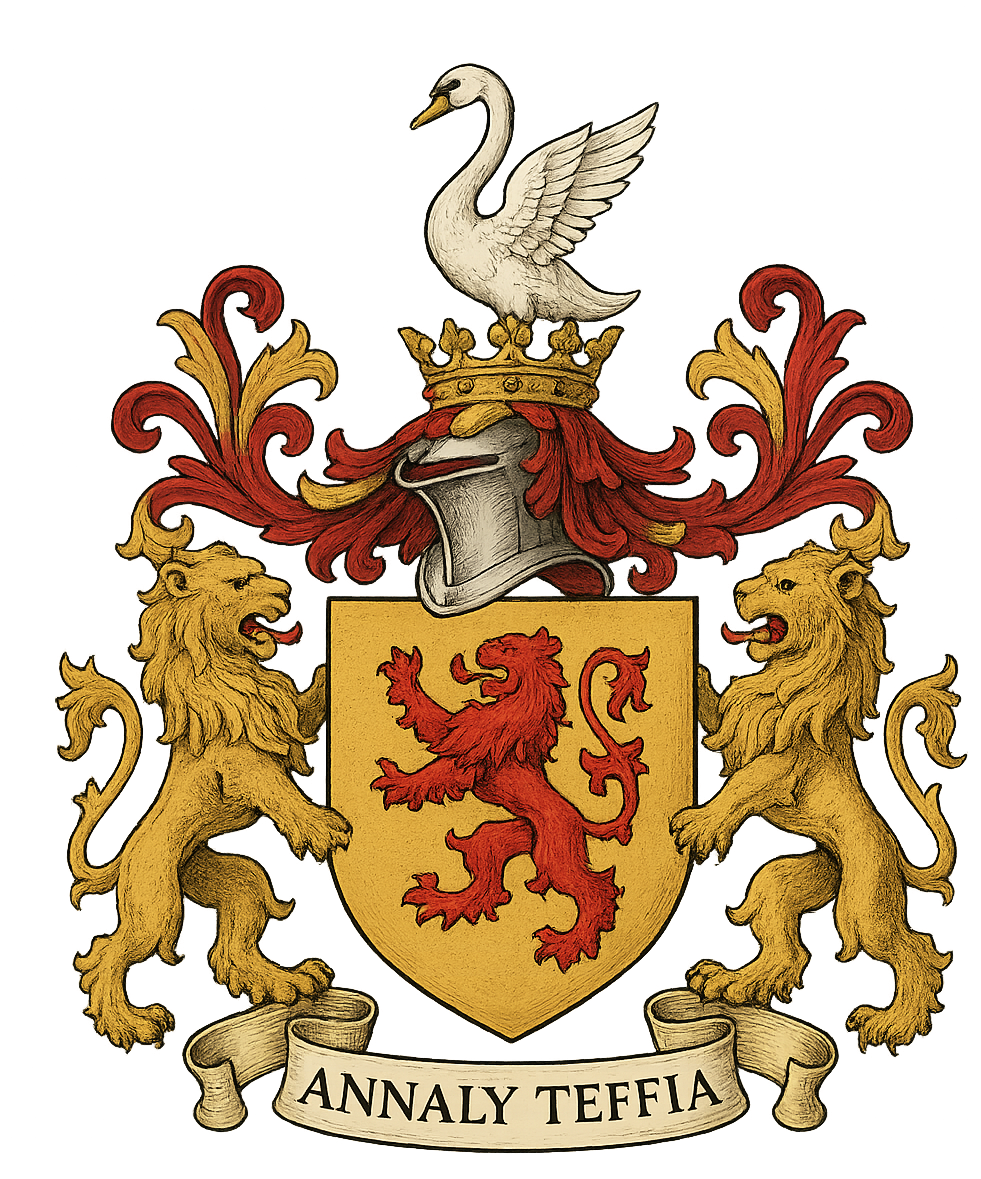
and then gives the Farrell arms, crest, supporters and motto.
That's precisely the type of British nobiliary/genealogical usage
you were describing.
Burke's and Debrett's
The search results confirm that Annaly.org attributes similar
treatment to Burke's Peerage and Debrett's, but at present the
searchable web results lead back to Annaly.org rather than giving me scans of
the relevant Burke's and Debrett's pages themselves.
So I would presently make the bibliography:
Verified
- Nichols — History and Antiquities of the County of Leicester —
Farrell pedigree: “descended from the Princes of Annaly.”
- O'Hart — Irish Pedigrees — O'Farrell pedigree expressly
titled “Princes of Annaly.”
- Historical Irish sources establish Annaly as the
territorial lordship of the O'Farrells; modern Farrell Clan historical
material continues the designation.
To locate by exact edition/page
- Burke's Landed Gentry
- Burke's Peerage, Baronetage and Knightage
- Burke's Irish Family Records
- Burke's Genealogical and Heraldic History of the Landed
Gentry of Ireland
- Debrett's Peerage and Baronetage
- Debrett's Baronetage / Peerage of the United
Kingdom
- Older Irish landed-family pedigrees containing
Farrell/O'Farrell maternal descents.
And your idea of searching other peerage biographies is particularly good. We
shouldn't search only the O'Farrell entry. A Burke's pedigree for an English or
Irish noble family might say, for example, that an ancestor married a daughter
of a Farrell “of the ancient Princes of Annaly.” Nichols already
demonstrates exactly this phenomenon.
That potentially gives us dozens of independent appearances of the
designation scattered throughout British landed-family genealogies.
The evidentiary value is also slightly different from what we've
been discussing about the modern Honour. These sources do establish that “Princes of Annaly” was accepted
conventional genealogical language in respectable British
historical/genealogical literature, rather than a designation recently
invented for the modern Honour.
The best verified references I found are:
- Bernard Burke, Heraldic Illustrations, with Annotations, vol. III
(1853). In the arms associated with the Worthington/Farrell
connection, Burke writes: “O’Ferrall, Princes of Annaly in Ireland.” This
is especially useful because Burke is not merely discussing Irish folklore;
he is using the description in a British heraldic-genealogical work while
tracing an English landed-family quartering.
- John Woody Papworth, An Alphabetical Dictionary of Coats of Arms Belonging to
Families in Great Britain and Ireland. Under Farrell, Papworth
identifies the Connaught family as “descended from the Princes of Annaly,” and
connects the line with Farrell of Skeffington Hall, Leicestershire, and
Farrell families in Dublin and Cheshire. This is a particularly good
example of the phrase entering mainstream British armorial genealogy
through descendants outside Longford itself.
- John O’Hart, Irish Pedigrees; or, The Origin and Stem of the Irish
Nation, 5th ed. (1892), vol. I. The entire O’Farrell pedigree is
expressly headed “Princes of Annaly.” O’Hart repeats the
designation elsewhere when discussing Awly O’Farrell, calling his line the
“O’Farrell (Princes of Annaly) pedigree.”
- O’Hart, The Irish Landed Gentry When Cromwell Came to
Ireland. Again, when tracing descendants through Awly O’Farrell,
O’Hart explicitly refers readers to the “O’Farrell (Princes of Annaly) pedigree.”
- British landed-family histories derived from the
Farrell–Skeffington line. One published English local history
describes William Farrell as originally from Connaught and
“descended from the princes of Annaly,” adding
that the family had borne those arms from time immemorial. The marriage
carried that ancestry into the Skeffington estate in Leicestershire.
- James P. Farrell, History of the County Longford (1891/1894).
This historical work repeatedly identifies the O’Ferrall sept as the
“Princes of Annaly” and treats their government
as the ruling dynasty of the territory.
- Later Irish genealogical/armorial literature.
The same formulation survived into derivative genealogical works:
“O’Ferrall, Princes of Annaly” and “ancient princes of Annaly” appear in
armorial and county-history material rather than only in modern clan
publications.
There is also an important National Library of Ireland manuscript pedigree,
Roger O’Ferrall’s Linea Antiqua, dated 1709. I have confirmed the NLI
catalogue record for that 241-page genealogical manuscript, although the catalogue
description itself does not provide a searchable “Princes of Annaly” quotation. It
would be valuable as an earlier pedigree source if the manuscript can be
inspected.
On Burke, therefore, we can now be definite: Burke did
not merely imply princely ancestry. Bernard Burke actually printed
“O’Ferrall, Princes of Annaly in Ireland.”
On Debrett’s, I am still more cautious. I found modern
assertions that Debrett’s recognized the princely origin, but I have
not yet obtained a digitized Debrett’s primary page
containing the exact phrase. The search results currently point
principally to modern Annaly material rather than a scan of Debrett’s itself.
So I would presently list Debrett’s as reported/awaiting exact page verification, rather
than quote it as though I had the original page in front of me.
The overall evidentiary conclusion is nevertheless quite strong:
by the nineteenth century, “Princes of Annaly” was established language in mainstream
British heraldic and genealogical literature, including Bernard Burke.
It was also used when describing descendants of the O’Farrell line who had
entered English landed families—not merely as a local Irish courtesy style.
That is significant for your Annaly analysis because it
demonstrates that Annaly itself was conventionally understood as a princely
territorial dignity in British nobiliary genealogy long before the modern
Westmeath conveyance. What it does not by itself decide is whether
that princely characterization followed the later alienable Honour/Seignory;
that remains the succession question we have been examining.